Table of contents
- Key facts about Florida’s memory disorder clinics
- What a memory disorder clinic does
- Who can go, and what it costs
- How to get an appointment
- What happens at the evaluation
- Memory disorder clinic Florida directory: all 17 clinics by region
- What to bring to the appointment
- After the diagnosis: next steps
- Frequently asked questions
- Sources
- Dementia stages, symptoms and behaviors
If you are looking for a memory disorder clinic, Florida has 17 of them, designated and partly funded by the state through the Florida Department of Elder Affairs’ Alzheimer’s Disease Initiative. They are spread across 13 service areas, from Pensacola to Miami Beach, and each one offers full evaluations for memory loss, a diagnosis, and referrals to local help. To get seen, find the clinic that serves your county in the directory below, then call the clinic directly or ask your loved one’s primary care doctor for a referral.
Key facts about Florida’s memory disorder clinics
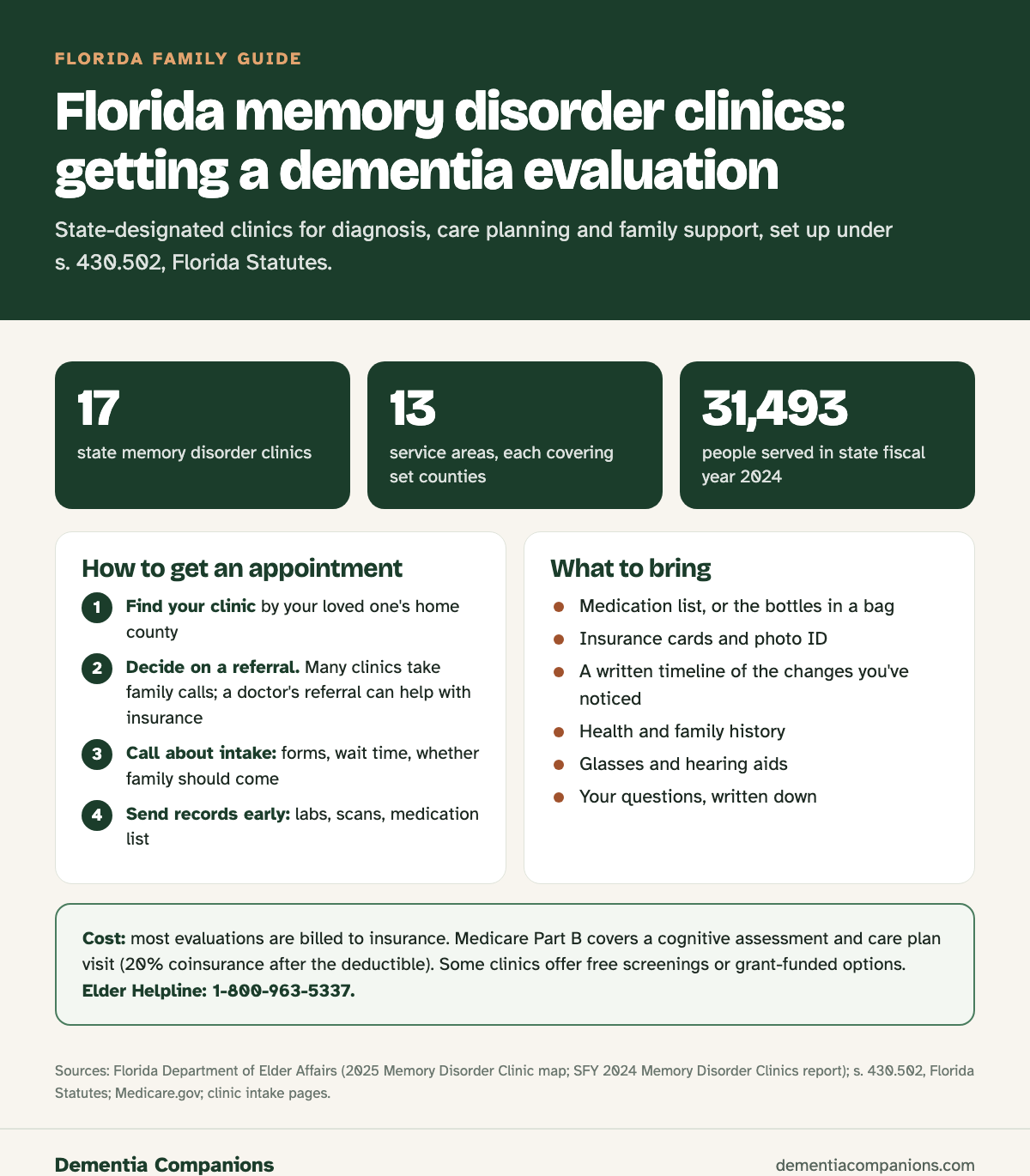
- 17 clinics, 13 service areas. The Florida Legislature has authorized 17 Memory Disorder Clinics (MDCs) operating in 13 service areas (Florida Department of Elder Affairs, 2025 MDC map).
- Created in 1985. The first clinics opened in 1985 with the creation of the Alzheimer’s Disease Initiative. The 17th clinic was added in 2019 through House Bill 449 (DOEA, SFY 2024 MDC report).
- More than 31,000 people served in one year. In state fiscal year 2024, the 17 clinics served 31,493 people with concerns about cognitive changes (DOEA, SFY 2024 MDC report).
- Set in state law. Florida Statutes section 430.502 establishes the clinics for research and training “in a diagnostic and therapeutic setting” for people with Alzheimer’s disease and related memory disorders.
- Large need. The DOEA report puts the number of Floridians living with Alzheimer’s disease at just over 580,000, second highest among US states.
- Medicare coverage exists. Medicare Part B covers a separate visit for a cognitive assessment and care plan. You pay 20% of the Medicare-approved amount after the Part B deductible (Medicare.gov).
- Statewide help line. The Elder Helpline, 1-800-96-ELDER (1-800-963-5337), connects families to their local Aging and Disability Resource Center.
What a memory disorder clinic does
A memory disorder clinic is a specialty program built to answer one question well: what is causing these memory and thinking changes? Under section 430.502, Florida’s clinics sit at medical schools, teaching hospitals and nonprofit health systems. The state requires them to provide comprehensive assessments, diagnosis and treatment, and to run caregiver training and service-related research.
In practice, that means a team rather than a single doctor. Depending on the clinic, the team may include neurologists, geriatricians or geriatric psychiatrists, nurse practitioners, neuropsychologists and social workers. The DOEA report notes that a full assessment can lead to better care planning and “may even identify situations where dementia symptoms were caused by other conditions.” Thyroid problems, vitamin deficiencies, medication side effects, depression and sleep problems can all look like dementia, and some are treatable.
The clinics also do work that families often don’t expect:
- Referrals to community services such as adult day programs, respite care, support groups and legal or financial planning help.
- Caregiver education classes and support groups.
- Free memory screenings at community events (several clinics report these in their DOEA annual highlights).
- Access to research studies and clinical trials for people who want to take part.
Who can go, and what it costs
The clinics serve adults with memory or thinking concerns and their families. Each clinic covers a set of counties (listed in the directory), so start with the one assigned to your loved one’s home county.
State funding pays for part of each clinic’s work, but most evaluations are still billed to insurance. What we could confirm from official sources:
- Insurance is usually billed. Tallahassee Memorial’s clinic verifies insurance before the appointment and notes that some policies require a physician’s referral to cover the evaluation.
- Medicare. Medicare Part B covers a cognitive assessment and care plan visit, with 20% coinsurance after the Part B deductible.
- Grant-funded options exist at some clinics. Florida Atlantic University’s Louis and Anne Green Memory and Wellness Center offers a “grant-funded no-cost referral form” and free memory screenings. The Madonna Ptak Center in Clearwater reported 38 free assessments for people without insurance in fiscal year 2024.
- Free screenings. Health First, Sarasota Memorial and Mount Sinai’s Wien Center all advertise free memory screenings. A screening is a short check, not a diagnosis, but it can tell you whether a full evaluation makes sense.
Costs and payment rules differ by clinic and by plan. Ask two questions when you call: “Do you take my loved one’s insurance?” and “Is there any grant-funded or reduced-cost option if we are uninsured?” For help with costs after diagnosis, see our guide to Florida programs that help pay for dementia care.
How to get an appointment
Here is the simplest path, based on how the clinics describe their intake.
- Find your clinic. Use the directory below to match your loved one’s county to a clinic. In Palm Beach, Orange and Miami-Dade areas you will have more than one choice.
- Decide on a referral. Many clinics take calls directly from families. The Medical Center Clinic in Pensacola says patients “may contact the clinic directly or arrange a referral through a personal physician,” and Tallahassee Memorial says self-referral is possible. Even so, a referral from the primary care doctor often helps with insurance and speeds up records transfer.
- Call and ask about intake. Ask what forms to fill out, whether they need records sent ahead, how long the wait is, and whether a family member should come.
- Send records early. Recent lab results, any brain scans (CT or MRI) and a list of current medications save time and can prevent repeat tests.
- Plan the day. Some evaluations take several hours or span more than one visit. Arrange a ride and a quiet afternoon afterward.
If your parent resists going, frame the visit as a routine check-up for memory, the same way they might get their eyes or hearing checked. Our article on making doctor visits easier for someone with dementia has more practical tips.
What happens at the evaluation
Each clinic runs its own process, but published descriptions follow a similar pattern. The University of Miami’s Memory Disorders Clinic, for example, lays out four stages: an initial evaluation, diagnostic testing, a results visit with a care plan, and ongoing follow-up.
The first visit
Expect a long conversation. Tallahassee Memorial describes a first visit that includes a review of medical records, a discussion of symptoms, a medical assessment with a cognitive evaluation, and a brief psychosocial assessment by the social work team. Clinicians will ask about memory, mood, behavior, sleep, medications and how your loved one handles daily tasks like bills, cooking and driving. Your observations as a family member carry real weight here.
Testing
Depending on what the team sees, they may order:
- Blood work to rule out reversible causes.
- Brain imaging such as MRI or CT.
- Neuropsychological testing, a longer set of pencil-and-paper or computer tasks that measures memory, language, attention and problem solving.
The results visit
The team meets with the patient and family to explain the findings, give a diagnosis when one is clear, and lay out a care plan. That plan can include medication, safety guidance (including driving), referrals for caregiver support and follow-up visits to track changes over time. If you want a sense of what a diagnosis may mean for the months ahead, read our overview of the stages of dementia.
Memory disorder clinic Florida directory: all 17 clinics by region
The table follows the 13 service areas on the Florida Department of Elder Affairs 2025 map, running roughly from the Panhandle south to Miami. Counties served come from the DOEA state fiscal year 2024 report. A phone number is shown only where the number on the DOEA 2025 map matched the clinic’s own official page when we checked on October 22, 2026. Where the two sources listed different numbers, we left the phone out; use the clinic’s official page to reach the right line.
| Region and counties served | Clinic | Host institution | City | Phone | Official page |
|---|---|---|---|---|---|
| 1: Bay, Escambia, Holmes, Jackson, Okaloosa, Santa Rosa, Walton, Washington | Memory Disorder Clinic at Medical Center Clinic | Medical Center Clinic (West Florida) | Pensacola | (850) 474-8353 | medicalcenterclinic.com |
| 2: Calhoun, Franklin, Gadsden, Gulf, Jefferson, Leon, Liberty, Madison, Taylor, Wakulla | Memory Disorder Clinic | Tallahassee Memorial HealthCare | Tallahassee | (850) 431-5001 | tmh.org |
| 3: Baker, Clay, Columbia, Duval, Flagler, Hamilton, Nassau, North Volusia, Putnam, St. Johns, Suwannee | Memory Disorder Clinic | Mayo Clinic | Jacksonville | See official page | mayoclinic.org |
| 4: Alachua, Bradford, Citrus, Dixie, Gilchrist, Lafayette, Levy, Marion, Union | Memory Disorder Clinic (UF Health Neuromedicine, Fixel Institute) | University of Florida | Gainesville | (352) 294-5400 | ufhealth.org |
| 5: Hernando, Lake, Orange, Polk, Seminole, Sumter | Center for Aging and Memory Disorder Clinic | Orlando Health Neuroscience Institute | Orlando | See official page | orlandohealth.com |
| 5: Hernando, Lake, Orange, Polk, Seminole, Sumter | AdventHealth Memory Disorder Clinic | AdventHealth | Orlando | See official page | adventhealthneuroinstitute.com |
| 6: Brevard, Indian River, Osceola, St. Lucie, South Volusia | Health First Memory Disorder Clinic | Health First | Melbourne | (321) 434-7614 | hf.org |
| 7: Pasco, Pinellas | Madonna Ptak Center for Alzheimer’s Research and Memory Disorders Clinic | Morton Plant Hospital (BayCare) | Clearwater | (727) 298-6025 | baycare.org |
| 8: Hardee, Hillsborough, Manatee | USF Memory Disorders Clinic | University of South Florida | Tampa | (813) 974-3100 | health.usf.edu |
| 9: Martin, Okeechobee, Palm Beach | St. Mary’s Medical Center Memory Disorder Clinic at Palm Beach Neuroscience Institute | St. Mary’s Medical Center | West Palm Beach (second site in Boynton Beach) | (561) 990-2135 | pbni.com |
| 9: Martin, Okeechobee, Palm Beach | Louis and Anne Green Memory and Wellness Center | Florida Atlantic University | Boca Raton | (561) 297-0502 | faunursing.org |
| 10: DeSoto, Highlands, Sarasota | Sarasota Memorial Hospital Memory Disorder Clinic | Sarasota Memorial Hospital | Sarasota | (941) 917-7197 | smh.com |
| 11: Charlotte, Collier, Glades, Hendry, Lee | Lee Physicians Group Memory Care Clinic | Lee Health | Fort Myers | (239) 343-9220 | leehealth.org |
| 12: Broward | Broward Health Memory Disorder Center | Broward Health (Broward Health North) | Deerfield Beach | (954) 786-7392 | browardhealth.org |
| 13: Miami-Dade, Monroe | Wien Center for Alzheimer’s Disease and Memory Disorders | Mount Sinai Medical Center | Miami Beach | (305) 674-2543 | msmc.com |
| 13: Miami-Dade, Monroe | Memory Disorders Clinic, Center for Cognitive Neuroscience and Aging | University of Miami | Miami | See official page | med.miami.edu |
| 13: Miami-Dade, Monroe | Frank C. and Lynn Scaduto MIND Institute | Miami Jewish Health | Miami | (305) 514-8652 | miamijewishhealth.org |
Volusia County is split between two regions: the north is served by Mayo Clinic in Jacksonville and the south by Health First in Melbourne. If you are unsure which clinic covers your address, call the Elder Helpline at 1-800-963-5337 or check the DOEA map linked in the sources.
What to bring to the appointment
- A full medication list, including over-the-counter drugs, sleep aids and supplements, with doses. Better yet, bring the bottles in a bag.
- Insurance cards (Medicare, Medicare Advantage or supplement, Medicaid, and any other coverage) and a photo ID.
- Recent records: lab results, brain scan reports and notes from other specialists, if the clinic did not already receive them.
- A short written timeline of changes you have noticed: when they started, examples (missed bills, getting lost, repeating questions), and whether they came on slowly or suddenly.
- Health history: past strokes, head injuries, heart disease, diabetes, depression, hearing or vision problems, and any family history of dementia.
- Glasses and hearing aids, so test results reflect thinking, not trouble seeing or hearing.
- Legal paperwork such as a health care surrogate designation or durable power of attorney, if one exists.
- Your questions, written down, plus a notebook to record answers.
After the diagnosis: next steps
A diagnosis is the start of planning, not the end of the conversation. Most clinics stay involved through follow-up visits, and their social workers can connect you to local services. A few steps to take in the first weeks:
- Get the care plan in writing and share it with the primary care doctor.
- Book the follow-up visit before you leave the clinic.
- Call the Elder Helpline (1-800-963-5337) to reach your Area Agency on Aging. The Alzheimer’s Disease Initiative also funds respite care, case management, caregiver training and support groups through these agencies.
- Handle legal and money matters early, while your loved one can still take part in decisions.
- Look at safety at home, including driving, medications, stoves and wandering risk.
We walk through each of these in detail in what to do after a dementia diagnosis in Florida, and our Florida dementia resources guide lists statewide and local organizations.
Many families also find that a parent who lives alone or at home with a busy spouse needs regular company and help with the day. Dementia Companions matches Florida families with companion caregivers screened for dementia care experience. Families watch video interviews and choose who they want, and every companion completes Florida’s ADRD training before the first visit. This is companion care, not medical care. You can meet our caregivers or call (786) 432-5758.
Frequently asked questions
How many memory disorder clinics are in Florida?
Florida has 17 state-designated Memory Disorder Clinics operating in 13 service areas, according to the Florida Department of Elder Affairs. They are hosted by medical schools, teaching hospitals and nonprofit health systems. Some regions, such as Orlando, Palm Beach County and Miami-Dade, have more than one clinic.
Do I need a referral to go to a memory disorder clinic in Florida?
Not always. Several clinics, including those in Pensacola and Tallahassee, accept calls directly from patients and families. However, some insurance plans require a physician’s referral to cover the evaluation, so ask the clinic and the insurer before the visit.
Can I get a free memory test in Florida?
Yes, in many areas. Several state-designated clinics, including Health First, Sarasota Memorial, FAU’s Memory and Wellness Center and Mount Sinai’s Wien Center, offer free memory screenings. A screening is a brief check that shows whether a full evaluation is a good idea; it does not give a diagnosis.
Does Medicare pay for a dementia evaluation?
Medicare Part B covers a separate visit for a cognitive assessment and care plan, and you pay 20% of the Medicare-approved amount after the Part B deductible. Other tests ordered during an evaluation, such as imaging or lab work, are billed under their own coverage rules. Check with the clinic and your plan about what your share will be.
How long does a memory evaluation take?
It depends on the clinic and on what testing is needed. Many clinics spread the work across more than one visit: an initial evaluation, any testing such as imaging or neuropsychological tests, and a separate results visit. Ask the clinic how much time to plan for when you book.
Still have questions?
Talk it through with us. A free call about your family's situation, with no obligation.
Call (689) 333-6079Send us a message- Screened for dementia care experience
- Florida ADRD training before the first visit
Sources
- Florida Department of Elder Affairs, Alzheimer’s Disease Initiative (ADI): https://elderaffairs.org/programs-and-services/alzheimers-disease-initiative-adi/
- Florida Department of Elder Affairs, Memory Disorder Clinics and the Florida Brain Bank map (2025): https://elderaffairs.org/wp-content/uploads/2025/12/2025-MDC-Map.pdf
- Florida Department of Elder Affairs, Florida Memory Disorder Clinics and Brain Bank, State Fiscal Year 2024 Report: https://elderaffairs.org/wp-content/uploads/2025/12/Memory-Disorder-Clinics-and-Brain-Bank-Annual-Report-2022-2023.pdf
- Florida Statutes, section 430.502, Alzheimer’s disease; memory disorder clinics and day care and respite care programs: https://www.flsenate.gov/Laws/Statutes/2025/430.502
- Florida Department of Elder Affairs, Aging and Disability Resource Centers and Elder Helpline: https://elderaffairs.org/resources/aging-and-disability-resource-centers-adrcs/
- Medicare.gov, Cognitive assessment and care plan services: https://www.medicare.gov/coverage/cognitive-assessment-care-plan-services
- Tallahassee Memorial HealthCare, Memory Disorder Clinic: https://www.tmh.org/memory
- Medical Center Clinic, Memory Disorder Clinic: https://www.medicalcenterclinic.com/specialties?bid=5246
- Florida Atlantic University, Louis and Anne Green Memory and Wellness Center: https://www.faunursing.org/mwc/
- University of Miami, Memory Disorders Clinic: https://med.miami.edu/centers-and-institutes/center-for-cognitive-neuroscience-and-aging/clinical-services/memory-disorders-clinic
- Clinic official pages for each entry are linked in the directory table above (checked October 22, 2026).
Want a companion screened for dementia care experience?
We'll send 3-5 caregiver video profiles within 48 hours, so you can watch their video interviews before you decide. $35/hour for 40+ hours a week, no contracts.