
Table of contents
- Key facts
- How many hours of care does a person with dementia need at each stage?
- Signs your parent needs more hours of care
- How to work out your parent’s dementia care hours
- A sample week: family, adult day and companion care
- Part-time vs. full-time dementia care: common schedules compared
- When does someone with dementia need 24-hour care?
- Protect the family caregiver’s hours too
- Getting help in Florida
- Watch a caregiver before you choose
- Frequently asked questions
- Sources
- Choosing in-home dementia care in Florida
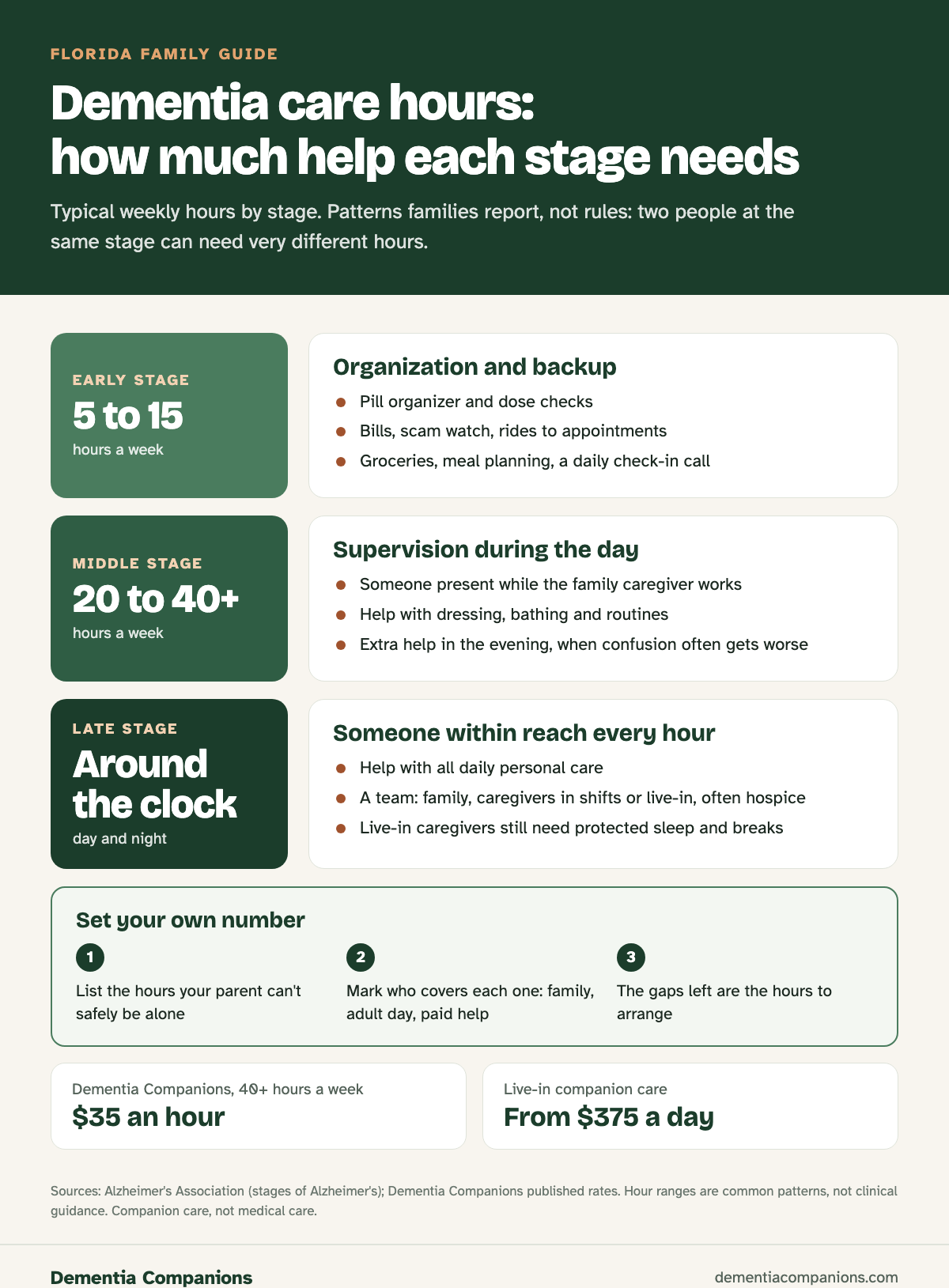
How many hours of care does a person with dementia need? It depends mostly on the stage: in the early stage many people need only a few hours of help a week, in the middle stage needs often grow to 20 to 40 or more hours of help and supervision, and in the late stage people need round-the-clock assistance. The most reliable way to set your number is to count the hours your parent cannot safely be alone, then plan who covers each one.
This guide walks through dementia care hours at each stage, the signs that it’s time to add hours, a sample week that mixes family, adult day and paid help, and what common schedules cost in Florida.
Key facts
- Nearly 13 million Americans provide unpaid care for a family member or friend with dementia, and in 2025 they gave more than 19 billion hours of care valued at more than $446 billion (Alzheimer’s Association, 2026 Facts and Figures).
- In Florida, more than 877,000 caregivers give 1.38 billion hours of unpaid care (Alzheimer’s Association, Florida Gulf Coast Chapter). Divided evenly, that is about 1,570 hours per caregiver per year, or roughly 30 hours a week.
- Unpaid caregivers spent more than 100 hours a month on average helping older adults with dementia living in the community, compared with 73 hours for older adults without dementia (Kasper and colleagues, Health Affairs, using 2011 national data).
- In 35 of 39 states surveyed, at least one-third of dementia caregivers provide 20 or more hours of care a week (2021 CDC BRFSS data, Gaugler and colleagues, Innovation in Aging).
- Six in 10 people living with dementia will wander at least once, and many do so repeatedly (Alzheimer’s Association).
- 1 in 4 older adults report falling every year (CDC).
- The Florida median cost for a non-medical caregiver is $32 an hour, and adult day health care is $75 a day (CareScout Cost of Care Survey 2025).
How many hours of care does a person with dementia need at each stage?
The Alzheimer’s Association describes three broad stages. People move through them at different speeds, and a person can show signs of two stages at once. On average, a person with Alzheimer’s lives four to eight years after diagnosis but can live as long as 20 years. The hour ranges below are common patterns families report, not rules. Your parent’s health, home setup and personality matter as much as the stage label. If you’re not sure where your parent is, our guide to the stages of dementia can help.
Early stage: a few hours a week, often 5 to 15
In the early stage, the Alzheimer’s Association notes a person may still function independently, drive, work and take part in social activities. Help at this point is usually about organization and backup, not supervision. Common tasks include:
- Setting up a weekly pill organizer and checking that doses are taken
- Paying bills together and watching for scams
- Rides to appointments and taking notes during visits
- Grocery runs, meal planning and a daily check-in call
Many families cover this with a few visits a week and use the time to plan legal, financial and care decisions while their parent can take part.
Middle stage: often 20 to 40 or more hours a week
The Alzheimer’s Association calls the middle stage typically the longest, lasting many years, and says the person will need a greater level of care as it goes on. This is when the question shifts from “what does Mom need help with?” to “when can Mom be alone?” Common changes include confusion about time and place, trouble with dressing and bathing, a growing tendency to wander and get lost, and changes in sleep.
Many families reach full daytime coverage during this stage: someone present while the family caregiver works, plus help in the evenings when confusion often gets worse. Some people in this stage can still be alone for short stretches; others can’t be left for an hour. Two people at the same stage can need very different hours.
Late stage: around-the-clock help
In the late stage, the Alzheimer’s Association says people need around-the-clock assistance with daily personal care. They may lose the ability to walk, sit up, or swallow safely, and they can’t respond to emergencies on their own. That means someone needs to be within reach every hour of the day and night. At home, that usually takes a team: family members, paid caregivers working in shifts or a live-in arrangement, and often hospice or other medical professionals for clinical needs.
Signs your parent needs more hours of care
Needs rarely grow on a schedule. More often a single event shows you the current plan has a gap. Watch for these:
- Wandering or getting lost. Six in 10 people with dementia wander at least once. If your parent has left the house confused, even once, the hours they spend alone carry real risk.
- Night waking and sundowning. The Alzheimer’s Association describes sundowning as increased confusion from dusk through the night, with pacing, anxiety and trouble sleeping. If nights are restless, someone needs to be awake or close by.
- Falls or near-falls. One in four older adults falls each year, according to the CDC, and dementia adds poor judgment about steps, bathrooms and getting up at night.
- Medication mistakes. Doubled doses, missed doses or a pill organizer that looks untouched mean a check-in call is no longer enough.
- Kitchen and household safety. Burned pots, food left out, spoiled food in the fridge or unlocked doors at night.
- Caregiver exhaustion. This counts as much as any symptom. The Alzheimer’s Association reports that 59% of dementia caregivers feel high to very high emotional stress. If you’re sleeping badly, missing work or feeling short-tempered, the care plan needs more hours from someone other than you.
For a fuller checklist, see signs a parent with dementia needs more support.
How to work out your parent’s dementia care hours
A simple way to size the need is to walk through one ordinary week:
- List the hours your parent truly can’t be alone. Be honest about evenings, nights and bathing times.
- Mark which hours family can cover reliably, without anyone losing a job or going without sleep for weeks.
- See what adult day can cover. A good program gives structured activity, meals and supervision on weekdays. Our guide to adult day programs for dementia explains what to look for.
- The hours left over are your paid care hours. Add a few more for respite, so the main family caregiver gets regular time off.
- Revisit every few months, or right away after a fall, hospital stay or new behavior.
A sample week: family, adult day and companion care
Here is how one family might cover a mother in the middle stage who lives with her daughter. The daughter works weekdays from 9 to 5. A son lives nearby and covers part of the weekend. Mom can’t be left alone for more than a short stretch.
| Day | Morning | Afternoon | Evening and night |
|---|---|---|---|
| Monday | Adult day program, 9 a.m. to 3 p.m. | Companion, 3 to 6 p.m. (3 hours) | Daughter |
| Tuesday | Companion, 9 a.m. to 5 p.m. (8 hours) | Companion continues: lunch, walk, activities | Daughter |
| Wednesday | Adult day program, 9 a.m. to 3 p.m. | Companion, 3 to 6 p.m. (3 hours) | Daughter |
| Thursday | Companion, 9 a.m. to 5 p.m. (8 hours) | Companion continues: appointment or outing | Daughter |
| Friday | Adult day program, 9 a.m. to 3 p.m. | Companion, 3 to 6 p.m. (3 hours) | Daughter |
| Saturday | Son, 10 a.m. to 4 p.m. | Son (daughter has time off) | Daughter |
| Sunday | Daughter | Daughter | Daughter |
That adds up to 25 paid companion hours and 3 adult day days a week. At Florida medians from the CareScout Cost of Care Survey 2025 ($32 an hour for a non-medical caregiver and $75 a day for adult day health care), this week would cost about $800 for the companion hours and $225 for adult day, or roughly $1,025. Prices in your area will vary. The daughter still covers every night and most of Sunday, so this plan works only while Mom sleeps through the night. If night waking starts, the plan has to change.
Part-time vs. full-time dementia care: common schedules compared
The table below compares four common setups. The Florida median figures use CareScout’s published $32 hourly median and are illustrations, not quotes. The Dementia Companions column shows only our own published rates.
| Schedule | Typical hours | What it usually covers | Illustration at Florida median ($32/hour) | Dementia Companions published rate |
|---|---|---|---|---|
| A few hours a week | 4 to 12 hours a week, often 2 or 3 visits | Companionship, outings, errands, appointment rides, a break for the family caregiver | 8 hours: about $256 a week | Call us about shorter schedules |
| Part-time | 20 to 30 hours a week | Weekday daytimes while family works, meals, routines, supervision during the hours your parent can’t be alone | 25 hours: about $800 a week | Call us about shorter schedules |
| Full-time | 40 to 50 hours a week | Full weekday coverage, sometimes into evenings; family covers nights and weekends | 45 hours: about $1,440 a week | $35 an hour for 40 or more hours a week (40 hours: $1,400 a week) |
| Live-in or overnight | Caregiver lives in the home, or covers set overnight shifts | Presence day and night for someone who can’t be alone; live-in caregivers need protected sleep and breaks, so it is not the same as awake care all night | Round-the-clock hourly shifts (168 hours): about $5,376 a week | Live-in from $375 a day (7 days: from $2,625 a week) |
For a deeper breakdown of rates, payment options and what drives price, see our guide to the cost of in-home dementia care.
When does someone with dementia need 24-hour care?
Most people need someone present around the clock by the late stage, and some need it earlier. Common turning points are wandering at night, getting up and falling in the dark, being unable to use the phone or recognize an emergency, and needing help to the bathroom at night.
Why 24-hour care at home usually means live-in care or shifts
No single person can be awake and alert for 24 hours a day, seven days a week. So families usually choose one of two setups:
- Live-in care. One caregiver lives in the home and is there day and night. Under U.S. Department of Labor rules, an employer and a live-in worker can agree to exclude real meal, sleep and off-duty periods from paid hours, but if sleep or meal time is interrupted by a call to duty, that time counts as hours worked. Live-in works best when your parent mostly sleeps through the night and needs only occasional help.
- Shift care. Two 12-hour or three 8-hour shifts, with someone awake the whole time. This fits a parent who is up often at night, wanders or needs frequent repositioning. It costs much more, because every hour is paid at the hourly rate.
Many families mix the two: a live-in companion plus family taking some nights, or day shifts from paid caregivers plus a family member sleeping nearby. Keep in mind that Medicare does not pay for 24-hour-a-day care at home, or for custodial care such as help with bathing and dressing when that is the only care needed.
Protect the family caregiver’s hours too
When families count hours, they often forget to count their own. The Family Caregiver Alliance puts it plainly: if a loved one’s nighttime activity keeps you awake, ask a friend or relative, or hire someone, to take a turn so you can get a good night’s sleep. A plan that depends on one exhausted person usually breaks down suddenly, often after the caregiver gets sick. Building in regular time off is part of safe care, not a luxury. Our article on respite care without guilt covers how to start.
Getting help in Florida
If you’re adding hours, Dementia Companions matches Florida families with companion caregivers screened for dementia care experience. You watch video interviews and choose who comes to your parent’s home, and every companion completes Florida’s ADRD (Alzheimer’s disease and related dementias) training before the first visit. We provide companion care, not medical or home health care. You can meet our caregivers or call (786) 432-5758 to talk through how many hours your family needs.
Watch a caregiver before you choose
Families watch video interviews like these and choose their companion. No one is sent to your parent's home until you have watched them and said yes.



Frequently asked questions
How many hours of care does a person with dementia need per week?
There is no single number. A common pattern is a few hours a week in the early stage, 20 to 40 or more hours in the middle stage, and round-the-clock help in the late stage. The best guide is how many hours your parent can’t safely be alone.
Can a person with dementia be left alone?
Early on, often yes, for reasonable stretches. Once a person wanders, forgets the stove, can’t use the phone in an emergency or gets confused about time of day, time alone becomes risky.
When does someone with dementia need 24-hour care?
The Alzheimer’s Association says people in the late stage need around-the-clock help with daily personal care. Some people need it sooner because of night wandering, frequent falls or being unable to call for help. If nights are unsafe, it’s time to plan for overnight coverage.
What is the difference between live-in care and 24-hour care?
A live-in caregiver stays in the home but needs protected sleep and break time, so they are not awake all night. True 24-hour awake care uses two or three caregivers in shifts. Live-in suits people who mostly sleep through the night; shift care suits people who are up and active at night.
Does Medicare pay for dementia care hours at home?
Generally no, for this kind of help. Medicare does not cover 24-hour-a-day care at home, homemaker services unrelated to a care plan, or custodial care such as bathing and dressing when that is the only care needed. Families usually pay privately or use long-term care insurance, veterans benefits or Medicaid programs if eligible.
Still have questions?
Talk it through with us. A free call about your family's situation, with no obligation.
Call (689) 333-6079Send us a message- Screened for dementia care experience
- Florida ADRD training before the first visit
Sources
- Alzheimer’s Association, 2026 Alzheimer’s Disease Facts and Figures: https://www.alz.org/facts-and-figures
- Alzheimer’s Association, Florida Gulf Coast Chapter (Florida caregiver figures): https://www.alz.org/flgulfcoast
- Alzheimer’s Association, Stages of Alzheimer’s: https://www.alz.org/alzheimers-dementia/stages
- Alzheimer’s Association, Wandering: https://www.alz.org/help-support/caregiving/stages-behaviors/wandering
- Alzheimer’s Association, Sleep Issues and Sundowning: https://www.alz.org/help-support/caregiving/stages-behaviors/sleep-issues-sundowning
- Kasper JD, Freedman VA, Spillman BC, Wolff JL. The Disproportionate Impact of Dementia on Family and Unpaid Caregiving to Older Adults. Health Affairs, 2015: https://www.healthaffairs.org/doi/10.1377/hlthaff.2015.0536
- Gaugler JE and colleagues. The Public Health Implications of Dementia Caregiving in the US: Findings from the 2021 BRFSS. Innovation in Aging, 2023: https://pmc.ncbi.nlm.nih.gov/articles/PMC10738067/
- CDC, Older Adult Falls Data: https://www.cdc.gov/falls/data-research/index.html
- CareScout, Cost of Care Survey 2025, Median Cost Data Tables: https://www.carescout.com/cost-of-care
- Family Caregiver Alliance, Caregiver’s Guide to Understanding Dementia Behaviors: https://www.caregiver.org/resource/caregivers-guide-understanding-dementia-behaviors/
- U.S. Department of Labor, Fact Sheet #79B: Live-in Domestic Service Workers: https://www.dol.gov/agencies/whd/fact-sheets/79b-flsa-live-in-domestic-workers
- Medicare.gov, Home Health Services: https://www.medicare.gov/coverage/home-health-services
Want a companion screened for dementia care experience?
We'll send 3-5 caregiver video profiles within 48 hours, so you can watch their video interviews before you decide. $35/hour for 40+ hours a week, no contracts.