Table of contents
- Key facts
- Why nights get hard in dementia
- Overnight care for dementia: your options compared
- Set up the night: a home checklist
- Questions to ask any overnight provider
- When nights mean it’s time to call the doctor
- Finding a companion in Florida
- Watch a caregiver before you choose
- FAQ
- Sources
- Choosing in-home dementia care in Florida
Overnight care for dementia means someone is in the home at night to help a person living with dementia stay safe when they wake, wander, need the bathroom or become confused after dark. Families usually choose between taking turns themselves, a sleeping or awake overnight caregiver, live-in care, short respite stays, or a move to memory care. The right choice depends on how often your loved one is up at night, what they need when they wake, and how much rest the family caregiver is getting.
Key facts
- Alzheimer’s disease often changes sleep. People may sleep a lot or not enough, wake many times during the night, nap a lot during the day, and become restless or confused as daylight fades, which is called sundowning (National Institute on Aging).
- Six in 10 people living with dementia will wander at least once, and many do so repeatedly (Alzheimer’s Association).
- The median cost of a non-medical in-home caregiver in Florida is $32 an hour, according to CareScout’s Cost of Care Survey 2025 (July through November 2025). The national median is $35 an hour (CareScout).
- Florida’s Alzheimer’s Disease Initiative (ADI), run by the Department of Elder Affairs, offers respite for caregivers that includes in-home care, facility-based care, emergency respite and extended care of up to 30 days, delivered through Florida’s 11 Area Agencies on Aging (Florida Department of Elder Affairs).
- Medicare does not pay for 24-hour-a-day care at home, or for custodial care like help with bathing, dressing or using the bathroom when that is the only care a person needs (Medicare.gov).
- Delirium usually starts suddenly, over a few hours or days, and is often temporary and treatable. Infections such as urinary tract infections are a common cause (MedlinePlus).
Why nights get hard in dementia
Many families find that days are manageable and nights are not. A parent who is pleasant at lunch may be pacing, frightened or trying to “go home” at 2 a.m. Several things tend to stack up after dark.
Sundowning
The Alzheimer’s Association describes sundowning as increased confusion from dusk through night, with trouble sleeping, anxiety, agitation, pacing and disorientation. Tiredness from the day, a disrupted body clock, and low light that creates shadows can all feed it. Our guide to sundowning and dementia covers the evening hours in more detail.
Sleep changes
The brain changes of dementia can upset the sleep cycle, so a person may doze through the afternoon and then be wide awake at night. Medications and other health problems can also play a part. See dementia sleep changes and solutions for daytime habits that help.
Wandering
Night wandering is one of the scariest risks for families. A person may open a door, walk outside in the dark and not know how to get back. In Florida that can mean busy roads, canals and pools. Read more about dementia wandering in Florida.
Toileting and falls
Many night wakings start with a trip to the bathroom. In the dark, half-asleep and confused, a person is more likely to trip. The National Institute on Aging notes that people with Alzheimer’s are at greater risk of falling because they often have changes in depth perception, so a change from carpet to tile can look like a step. Our fall prevention guide has room-by-room fixes.
The caregiver’s own sleep
When the person with dementia is up at night, the family caregiver is too. NIA points out that both the person with Alzheimer’s and their caregiver need restful sleep. Weeks of broken nights wear people down, and that is often the real reason families start looking for overnight help.
Overnight care for dementia: your options compared
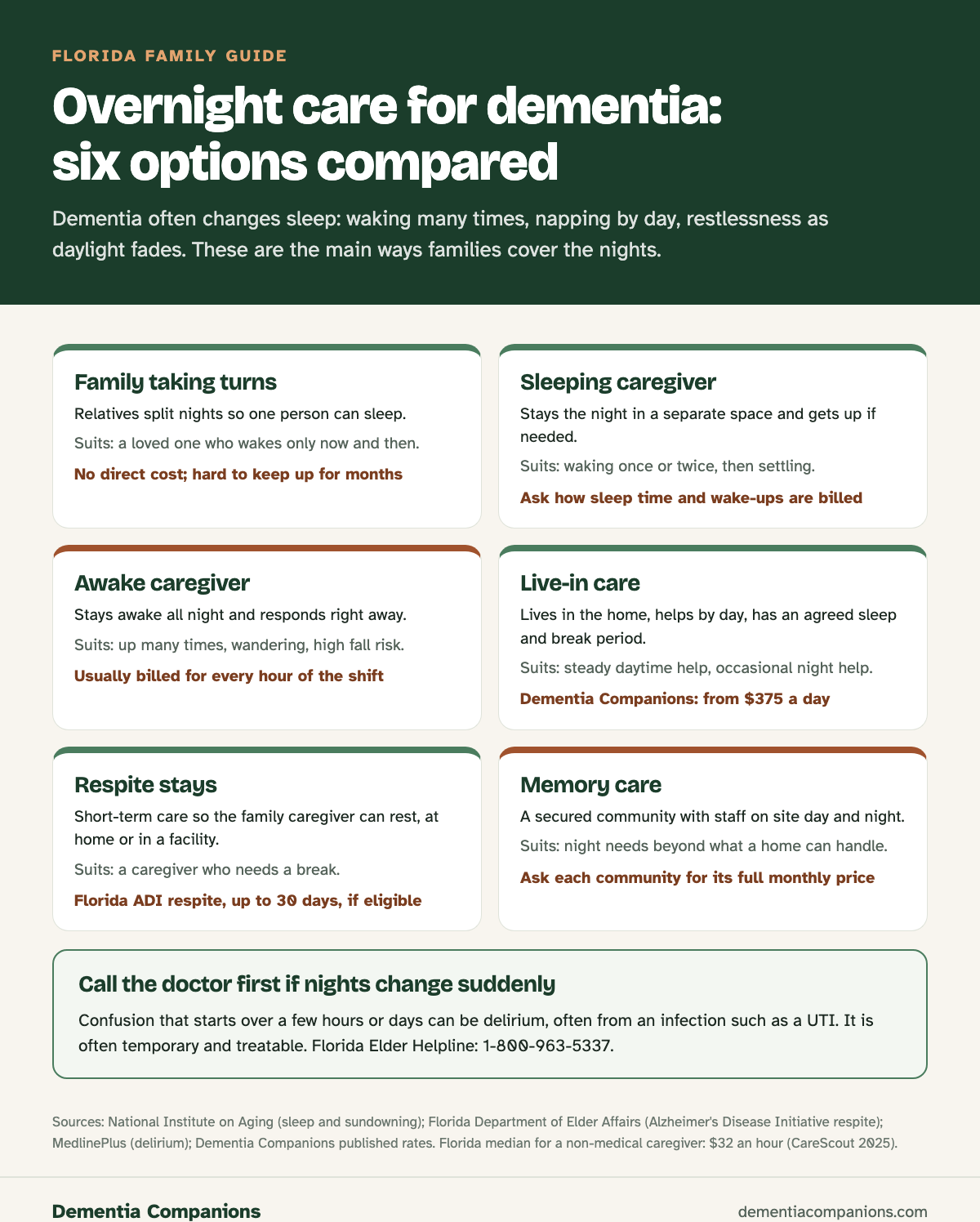
There is no single right answer. Here is how the common choices compare. Costs vary by provider and county, so use the figures below as a starting point and get written quotes.
| Option | What it covers | Who it suits | Cost notes |
|---|---|---|---|
| Family taking turns | Relatives split nights so one person can sleep. Someone is in the house if the person wakes. | Families with several nearby relatives and a loved one who wakes only now and then. | No direct cost, but the toll on work, health and sleep is real. Hard to keep up for months. |
| Overnight sleeping caregiver | A caregiver stays the night, sleeps in a separate space, and gets up if needed, for example to help with the bathroom or settle the person back to bed. | People who wake once or twice and settle again fairly easily. | Pricing differs by provider. Ask how sleep time and wake-ups are billed. The Florida median for a non-medical caregiver is $32 an hour (CareScout 2025). |
| Overnight awake caregiver | A caregiver stays awake all night, checks on the person and responds right away. | People who are up many times, wander, or have a high fall risk. | Usually billed for every hour of the shift. As an illustration only, a 10-hour night at the Florida median of $32 an hour would be $320. |
| Live-in care | A caregiver lives in the home, helps during the day, and has an agreed sleep and break period at night. | People who need steady company and help during the day and only occasional help at night. | Usually a daily rate. Dementia Companions’ rate: live-in from $375 a day. Ask how nights are handled if wake-ups become frequent. |
| Respite stays | Short-term care so the family caregiver can rest, either in the home or in a facility for a few days or weeks. | Caregivers who need a break, are recovering from illness, or are traveling. | Florida’s ADI program offers in-home, facility-based, emergency and extended respite (up to 30 days) for those who qualify. Call the Elder Helpline at 1-800-963-5337. |
| Memory care | A secured community with staff on site day and night. | People whose night needs have grown beyond what a home can safely handle. | The Florida median for an assisted living community is $5,610 a month (CareScout 2025). Memory care is not listed separately, so ask each community for its full monthly price. |
For daytime support alongside any of these, Dementia Companions’ rate is $35 an hour for 40 or more hours a week. Our in-home dementia care cost guide walks through budgeting.
Sleeping vs awake overnight care
The key question is how often your loved one wakes and what happens when they do. Keep a simple log for a week or two: the time they woke, why (bathroom, fear, pain, wanting to leave), and how long it took to settle. If they wake once and go back to sleep, a sleeping caregiver may be enough. If they are up every hour or try to leave the house, someone needs to be awake.
Live-in care vs overnight care
Live-in care is built around a caregiver who works during the day and rests at night. An overnight caregiver comes only for the night shift. If your loved one does fine during the day with family but struggles at night, overnight shifts may fit better. If the day is the harder part and nights are mostly quiet, live-in care can work well.
A note on rules: the US Department of Labor’s Fact Sheet #79B explains that a live-in domestic worker and employer may agree in writing to exclude sleep time and free time from paid hours, but if that time is interrupted by a call to duty, the interruption counts as hours worked. Rules differ by setup, so ask any provider how their live-in and overnight arrangements handle night wake-ups.
Set up the night: a home checklist
Whatever option you choose, a well-prepared home makes nights calmer and safer.
- Lighting. Use night lights in the bedroom, hallway and bathroom, as NIA recommends. Motion-sensor lights help too. Keep the evening calm with lower light, but avoid dark corners and shadows that can frighten.
- Door alarms. The Alzheimer’s Association suggests warning bells, door covers and deadbolts placed out of sight on outside doors. A simple chime on the front, back and patio doors tells you when a door opens.
- A clear bathroom path. Remove rugs and clutter between the bed and the toilet. Label the bathroom door with a picture. Add grab bars by the toilet and non-skid strips on the floor if it is tile.
- Bed or chair alarms. A pressure pad or motion sensor can alert a family member or caregiver when the person gets up. A room monitor, like a baby monitor, can also pick up sounds of a fall or call for help, as NIA suggests.
- A steady night routine. Go to bed and get up at the same times each day. Plan the busiest activities for the morning, limit late-day naps, and skip caffeine and alcohol. A relaxing bedtime with lower lights, a cool room, soft music and no screens can help.
- Safety basics. Check smoke detectors, keep emergency numbers by the phone, and secure the pool area. Keep a recent photo handy in case of wandering.
Questions to ask any overnight provider
- Is the caregiver awake all night or allowed to sleep? What happens if my loved one wakes several times?
- How are night wake-ups billed, and is there a minimum shift length?
- What dementia care experience does this caregiver have, especially with sundowning and wandering?
- Will the same caregiver come each night, or will it rotate? Consistency matters a lot for people with dementia.
- What will the caregiver do if my loved one tries to leave the house, falls, or seems suddenly unwell?
- Who do I call at 3 a.m. if there is a problem, and who covers if the caregiver is sick?
- Is this companion care, personal care or medical care? What tasks can and can’t the caregiver do?
- Can we meet or interview the caregiver before the first night?
- Is the caregiver an employee of the provider or an independent worker, and who handles payroll, taxes and insurance?
When nights mean it’s time to call the doctor
Some night troubles are part of dementia. Others are signs of something new. Call the doctor if sleep problems keep going despite a good routine. NIA notes that a health care provider may find a medical condition or medication that is causing the problem. The Alzheimer’s Association also suggests having a doctor check for issues like urinary tract infections or sleep apnea that can make sundowning worse.
Sudden changes need prompt attention. If your loved one becomes much more confused, sleepy, agitated or sees things over a few hours or days, it may be delirium rather than the dementia getting worse. MedlinePlus explains that delirium starts suddenly, often comes and goes, and is often treatable once the cause, such as an infection or a medication, is found. Contact the doctor right away, and call 911 if it looks like an emergency.
Finding a companion in Florida
Dementia Companions matches Florida families with companion caregivers screened for dementia care experience. Families watch video interviews and choose the companion who feels right. Every companion completes Florida’s ADRD (Alzheimer’s disease and related dementias) training before the first visit. We provide companion care, not medical or home health care. You can meet our caregivers or call (786) 432-5758 to talk through your options.
Watch a caregiver before you choose
Families watch video interviews like these and choose their companion. No one is sent to your parent's home until you have watched them and said yes.



FAQ
What is overnight care for dementia?
It is care in the home during the night for a person living with dementia. A caregiver stays overnight to help with bathroom trips, settle the person after night waking, watch for wandering and reduce the risk of falls, so the family caregiver can sleep.
How much does an overnight caregiver cost in Florida?
The Florida median for a non-medical in-home caregiver is $32 an hour (CareScout Cost of Care Survey 2025). Overnight rates depend on whether the caregiver sleeps or stays awake, the shift length and the provider. Ask for the full cost of a night in writing.
Does Medicare pay for overnight care at home?
No. Medicare does not pay for 24-hour-a-day care at home or for custodial care when that is the only care a person needs. Some long-term care insurance policies, VA benefits or Medicaid programs may help, so check your specific coverage.
Is there free respite care for dementia caregivers in Florida?
Florida’s Alzheimer’s Disease Initiative offers respite, including in-home, facility-based, emergency and extended care of up to 30 days, for adults 18 and older diagnosed with probable Alzheimer’s disease or a related dementia. Eligibility and any cost-sharing are set locally, so call the Elder Helpline at 1-800-963-5337 to reach your Area Agency on Aging.
When is it time for memory care instead of overnight help at home?
Consider memory care when night needs are frequent and unsafe even with good help, when the person needs more than one caregiver to move safely, or when the family can no longer cover the gaps. Talk it through with the doctor and visit communities before a crisis forces a fast decision.
Still have questions?
Talk it through with us. A free call about your family's situation, with no obligation.
Call (689) 333-6079Send us a message- Screened for dementia care experience
- Florida ADRD training before the first visit
Sources
- National Institute on Aging, Managing Sleep Problems in Alzheimer’s Disease: https://www.nia.nih.gov/health/sleep/managing-sleep-problems-alzheimers-disease
- National Institute on Aging, Alzheimer’s Caregiving: Home Safety Tips: https://www.nia.nih.gov/health/safety/alzheimers-caregiving-home-safety-tips
- Alzheimer’s Association, Sleep Issues and Sundowning: https://www.alz.org/help-support/caregiving/stages-behaviors/sleep-issues-sundowning
- Alzheimer’s Association, Wandering: https://www.alz.org/help-support/caregiving/stages-behaviors/wandering
- Alzheimer’s Association, Respite Care: https://www.alz.org/help-support/caregiving/care-options/respite-care
- CareScout, Cost of Care Survey 2025: Median Cost Data Tables: https://assets.carescout.com/x/8fcb50422f/282102.pdf
- Florida Department of Elder Affairs, Alzheimer’s Disease Initiative: https://elderaffairs.org/programs-services/alzheimers-disease-initiative-adi/
- Florida Department of Elder Affairs, Contact Us (Elder Helpline): https://elderaffairs.org/contact-us/
- Medicare.gov, Home Health Services: https://www.medicare.gov/coverage/home-health-services
- MedlinePlus, Delirium: https://medlineplus.gov/delirium.html
- US Department of Labor, Fact Sheet #79B: Live-in Domestic Service Workers Under the FLSA: https://www.dol.gov/agencies/whd/fact-sheets/79b-flsa-live-in-domestic-workers
Want a companion screened for dementia care experience?
We'll send 3-5 caregiver video profiles within 48 hours, so you can watch their video interviews before you decide. $35/hour for 40+ hours a week, no contracts.