Table of contents
- Key facts about Florida ADRD training
- What is ADRD training?
- Florida Alzheimer’s training requirements by setting
- What the 1-hour Alzheimer’s training in Florida covers
- What ADRD training means, and what it does not
- Questions families can ask any agency or caregiver
- Can families take Florida dementia training for caregivers?
- How Dementia Companions handles ADRD training
- Watch a caregiver before you choose
- FAQ
- Sources
- Choosing in-home dementia care in Florida
Florida ADRD training is the state’s required Alzheimer’s disease and related dementias education for workers at licensed or registered care providers. Under section 430.5025, Florida Statutes, staff who give personal care or have regular contact with clients must finish a free, one-hour Department of Elder Affairs course within 30 days of starting work, and many must complete 2 to 4 more hours within months. It is a legal minimum, so families should still ask to see each caregiver’s certificate and ask what experience sits behind it.
Information in this article was checked against the Florida Statutes and the Florida Department of Elder Affairs (DOEA) website on October 22, 2026. Laws and agency pages change, so confirm details with the provider and the sources listed at the end.
Key facts about Florida ADRD training
- The law is the “Alzheimer’s Disease and Related Forms of Dementia Education and Training Act,” s. 430.5025, Florida Statutes, created by chapter 2023-278, Laws of Florida.
- It covers “a nursing home, a home health agency, a nurse registry, a companion or homemaker service provider, a health care services pool, an assisted living facility, an adult family-care home, or an adult day care center licensed or registered under chapter 400 or chapter 429” (s. 430.5025(2)(a)).
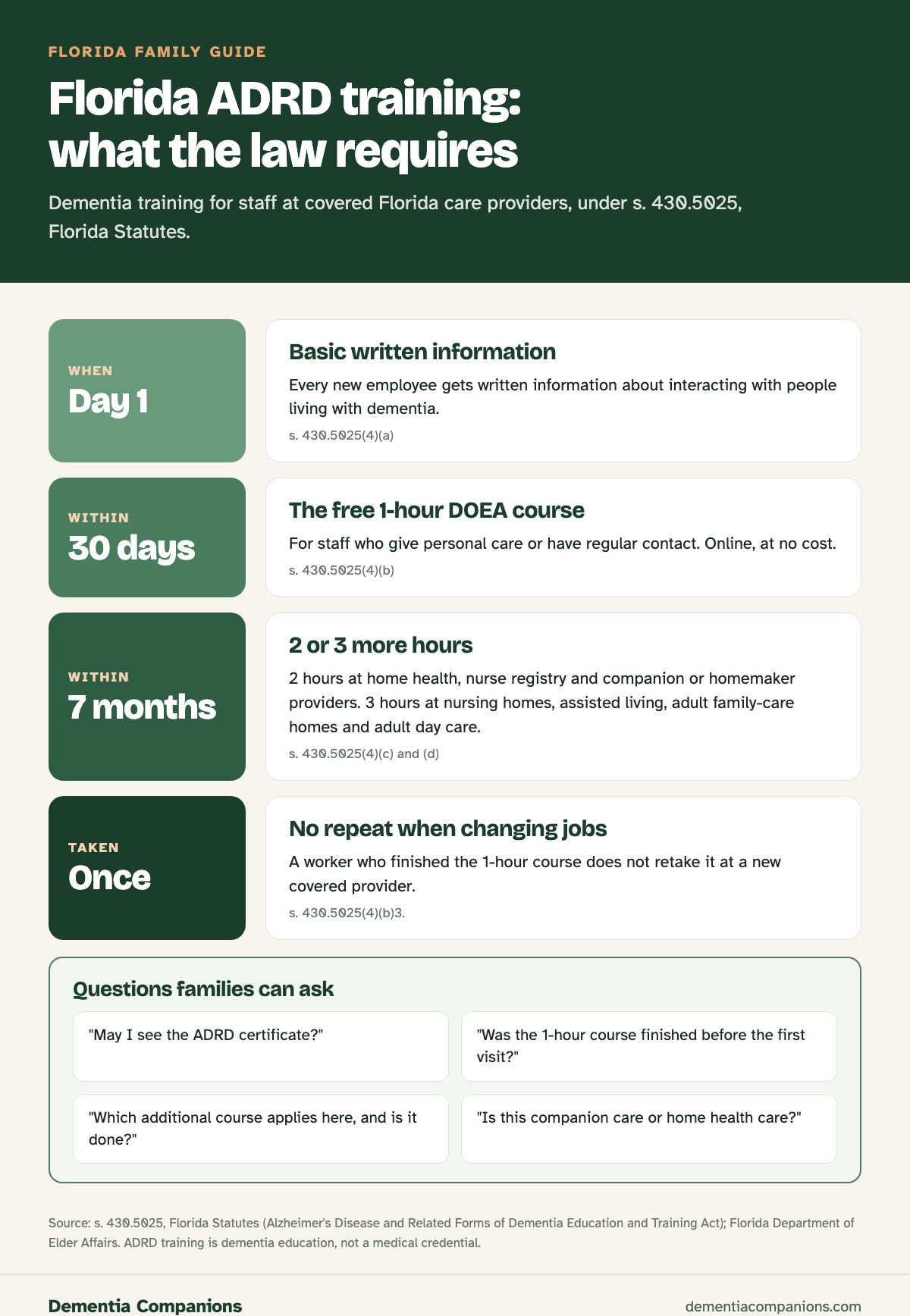
- Every new employee must receive “basic written information about interacting with persons who have Alzheimer’s disease or related forms of dementia” when they start (s. 430.5025(4)(a)).
- Within 30 days, employees who give personal care or have regular contact must complete “a 1-hour training program provided by the department,” which must be “available online at no cost” (s. 430.5025(4)(b)).
- Within 7 months, personal care staff must add 2 hours (home health agency, nurse registry, companion or homemaker provider) or 3 hours (nursing home, assisted living facility, adult family-care home, adult day care center) (s. 430.5025(4)(c) and (d)).
- Staff hired before July 1, 2023, had until July 1, 2026, to complete the training (s. 430.5025(9)).
- A worker who completed the one-hour course “is not required to repeat the program upon changing employment to a different covered provider” (s. 430.5025(4)(b)3.).
What is ADRD training?
ADRD stands for Alzheimer’s disease and related dementias. In Florida, “ADRD training” usually means the dementia education that s. 430.5025 requires for workers at certain care providers. The Department of Elder Affairs runs the free one-hour course, approves training providers and curricula for the longer courses, and lists approved trainers on its website.
The law applies to an “employee,” which it defines as “a person, contracted staff, or an independent contractor employed or referred by a covered provider who is required to undergo a level 2 background screening under s. 408.809 and chapter 435” (s. 430.5025(2)(d)). That means the rule reaches contract workers and caregivers referred by a nurse registry, not only payroll staff.
Personal care vs. regular contact
Two terms decide who takes which course. “Personal care” means “providing, through in-person contact, assistance with activities of daily living, assistance with self-administration of medication, homemaker or companion services, nursing services, or other services that promote the physical, mental, and psychosocial well-being” of clients. It does not include administrative work or upkeep such as “grounds maintenance, building maintenance, housekeeping, laundry, or food preparation” (s. 430.5025(2)(c)).
“Regular contact” means “the performance of duties other than personal care that may require employees to interact in person on a daily basis with participants, patients, or residents” (s. 430.5025(2)(e)).
Florida Alzheimer’s training requirements by setting
The table below lists only requirements we verified in the statute text. All rows except hospice also include the written information at hire and the one-hour DOEA course within 30 days.
| Setting | Who | Hours | Deadline | Legal source |
|---|---|---|---|---|
| All covered providers (listed above) | Every employee | Basic written information | “Upon beginning employment” | s. 430.5025(4)(a), F.S. |
| All covered providers | Employees who provide personal care or have regular contact | 1 hour (DOEA course) | “Within 30 days after beginning employment” | s. 430.5025(4)(b), F.S. |
| Home health agency, nurse registry, companion or homemaker service provider | Employees who provide personal care | 2 additional hours | “Within 7 months after beginning employment” | s. 430.5025(4)(c), F.S. |
| Nursing home, assisted living facility, adult family-care home, adult day care center | Employees who provide personal care | 3 additional hours | “Within 7 months after beginning employment” | s. 430.5025(4)(d), F.S. |
| Assisted living facility, adult family-care home or adult day care center that advertises or is designated for specialized Alzheimer’s care | Personal care or regular contact staff | 3 additional hours | “Within 3 months after beginning employment” | s. 430.5025(4)(e)1., F.S. |
| Same specialized settings | Employees who provide personal care | 4 more hours of dementia-specific training | “Within 6 months after beginning employment” | s. 430.5025(4)(e)2., F.S. |
| Same specialized settings | Employees who provide personal care | At least 4 hours of continuing education | “Each calendar year” after that | s. 430.5025(4)(e)3., F.S. |
| Health care services pool (staffing agency) | Workers it provides, assigns or refers | Whatever applies to the provider and position where they work | Same as that setting | s. 430.5025(4)(f), F.S. |
| Hospice (separate law) | Employees with direct contact | At least 1 hour | “Within the first 3 months after beginning employment” | s. 400.6045, F.S. |
| Hospice (separate law) | Employees providing direct care to a person with dementia | 3 additional hours | “Within 9 months after beginning employment” | s. 400.6045, F.S. |
A note on sources: the DOEA training page groups settings slightly differently from the statute in its summary table (for example, it shows nursing homes with home health under the 2-hour course). The statute text places nursing homes in the 3-hour group. When the two differ, the statute controls, and if you are unsure which rule applies to a particular provider, ask the provider to tell you in writing which paragraph of s. 430.5025 they follow. DOEA also states that hospice agencies are the one exception and follow rules 59A-38.019 and 59A-38.020, Florida Administrative Code, rather than s. 430.5025.
What the extra hours must cover
The 2-hour course for home health, nurse registry and companion or homemaker staff “must include, but is not limited to, behavior management, promoting the person’s independence in activities of daily living, and skills in working with families and caregivers” (s. 430.5025(4)(c)).
The 3-hour course adds “group and individual activities, maintaining an appropriate environment, and ethical issues” (s. 430.5025(4)(d)). The 4-hour specialized course covers “understanding Alzheimer’s disease and related forms of dementia, the stages of Alzheimer’s disease, communication strategies, medical information, and stress management” (s. 430.5025(4)(e)2.).
What the 1-hour Alzheimer’s training in Florida covers
By law, the one-hour program “shall contain information on understanding the basics about the most common forms of dementia, how to identify the signs and symptoms of dementia, and skills for communicating and interacting with persons with Alzheimer’s disease or related forms of dementia” (s. 430.5025(4)(b)1.).
In short, it teaches what dementia is, how to spot it, and how to talk with someone who has it. The statute does not list hands-on clinical skills among its topics.
How the course is taken and what the certificate shows
DOEA posts the required one-hour training video on its ADRD training page. The page’s instructions say the worker must watch “by yourself (NOT in a group),” wait for a completion form to appear after the video ends, use a desktop computer rather than a phone, and fill in the form completely. DOEA says the certificate arrives “within five business days” and that “You only need to take this training once.”
Per DOEA, a valid ADRD certificate lists the training program name, hours, curriculum approval number and expiration date, the trainee’s full name, the training date and location, and the trainer’s printed name, signature, date and approval number. The worker is responsible for giving a copy to the employer, and the employer keeps it in the personnel file, which DOEA says the Agency for Health Care Administration reviews during monitoring visits. The statute separately requires the covered provider to “maintain a record of the employee’s completion of the training program” (s. 430.5025(4)(b)2.).
What ADRD training means, and what it does not
A Florida ADRD certificate tells you a caregiver has met the state’s basic dementia education requirement for their setting. Someone who has done it should know how dementia differs from normal aging and have basic communication strategies.
It does not mean:
- Clinical skill. One to seven hours of education is not nursing training. A companion with an ADRD certificate still cannot give medical care.
- Experience. The course can be finished in an afternoon. It says nothing about how many people with dementia a caregiver has supported, or how they handle sundowning, refusals or wandering.
- A good match. Personality, language, patience and shared interests often matter more day to day than any certificate.
- State licensure of the person. The certificate shows course completion. It is not a professional license.
Think of ADRD training as a floor. It is the least a worker at a covered provider must know, not a sign of advanced dementia expertise. For a fuller checklist, see our guide on how to choose a dementia caregiver.
Questions families can ask any agency or caregiver
- “May I see the ADRD certificate?” Check the name, the date completed and the hours. A caregiver can share their own copy, and the statute lets employees request a copy of their record from the provider.
- “Was the one-hour course finished before the first visit, or is it still within the 30-day window?” The law allows up to 30 days after hire, so a brand-new worker may not have it yet. You can ask for someone who already does.
- “Has this caregiver done any dementia training beyond the one-hour course?” Some caregivers have taken longer courses. Ask for the course name and the date it was completed.
- “Which dementia training has this caregiver completed, and can I see the certificates?” A valid certificate shows the course name, the hours, the training date and the trainer, so ask to see it.
- “How much dementia experience does this caregiver have?” Ask for specific examples, such as how they respond when a person refuses a bath or asks for a parent who has died.
- “Who do I call if a behavior changes or something goes wrong?” Ask for a named contact and a plan.
- “Is this companion care or home health care?” These are different services with different rules. Our comparison of companion care vs. home health care explains what each can and cannot do.
Can families take Florida dementia training for caregivers?
The statute directs DOEA to “offer to the general public education about Alzheimer’s disease and related forms of dementia,” covering the common forms of dementia, signs and symptoms, “coping skills, how to respond to changes, planning for the future, and how to access additional resources” (s. 430.5025(3)).
On its ADRD page, DOEA posts the one-hour training video and an “Alzheimer’s and Dementia Awareness Resource and Information Guide” in English and Spanish. The video is publicly viewable, but the page is written for staff at licensed care settings and does not say whether a family member can or should request a certificate. Watching the video and reading the guide costs nothing; if you need a certificate, contact DOEA first. See also our family guide.
How Dementia Companions handles ADRD training
At Dementia Companions, every companion completes Florida’s ADRD training before the first visit. Caregivers are screened for dementia care experience, and families watch video interviews and choose the person they feel fits best. We provide companion care, not medical or home health care. You can meet our caregivers online or call (689) 333-6079 with questions.
Watch a caregiver before you choose
Families watch video interviews like these and choose their companion. No one is sent to your parent's home until you have watched them and said yes.


FAQ
What is ADRD training in Florida?
It is the dementia education that s. 430.5025, Florida Statutes, requires for employees of covered care providers, starting with a free one-hour DOEA course.
How long do new caregivers have to complete the 1-hour Alzheimer’s training in Florida?
Employees who provide personal care or have regular contact must complete it “within 30 days after beginning employment” (s. 430.5025(4)(b)). Hospice staff follow a different law, s. 400.6045, which allows the first 3 months.
Is the Florida ADRD 1-hour course free?
Yes. The statute says the department “shall provide training that is available online at no cost” (s. 430.5025(4)(b)1.), and DOEA posts the video on its website.
How many ADRD hours does a Florida home health or companion caregiver need?
The one-hour DOEA course within 30 days, plus 2 more hours within 7 months for staff who provide personal care at a home health agency, nurse registry, or companion or homemaker service provider (s. 430.5025(4)(c)).
Does a caregiver have to retake ADRD training when changing jobs?
No. A worker who completed the one-hour course does not repeat it at a new covered provider (s. 430.5025(4)(b)3.), and a completion record for the longer courses counts in the topics it covers (s. 430.5025(5)(c)). DOEA adds, “You only need to take this training once.”
Still have questions?
Talk it through with us. A free call about your family's situation, with no obligation.
Call (689) 333-6079Send us a message- Screened for dementia care experience
- Florida ADRD training before the first visit
Sources
- Section 430.5025, Florida Statutes (2026), Alzheimer’s Disease and Related Forms of Dementia Education and Training Act: https://www.flsenate.gov/Laws/Statutes/2026/430.5025
- Section 400.6045, Florida Statutes (2026), hospice dementia training: https://www.flsenate.gov/Laws/Statutes/2026/400.6045
- Florida Department of Elder Affairs, Alzheimer’s Disease and Related Dementias Training: https://elderaffairs.org/resources/alzheimers-disease-and-related-dementias-training/
- Florida Department of Elder Affairs, approved ADRD trainers and curricula: https://elderaffairs.org/adrd-training/trainers-curricula/
- Florida Administrative Code and Florida Administrative Register: https://www.flrules.org/
Last verified: October 22, 2026.
Want a companion screened for dementia care experience?
We'll send 3-5 caregiver video profiles within 48 hours, so you can watch their video interviews before you decide. $35/hour for 40+ hours a week, no contracts.