Table of contents
What to do after a dementia diagnosis: in the first month, book a follow-up visit to ask questions and get a care plan, call the Florida Elder Helpline at 1-800-963-5337 to find local help, and start the legal paperwork (a durable power of attorney and a health care surrogate) while your loved one can still take part. After that, look at driving, home safety and day-to-day support, one week at a time.
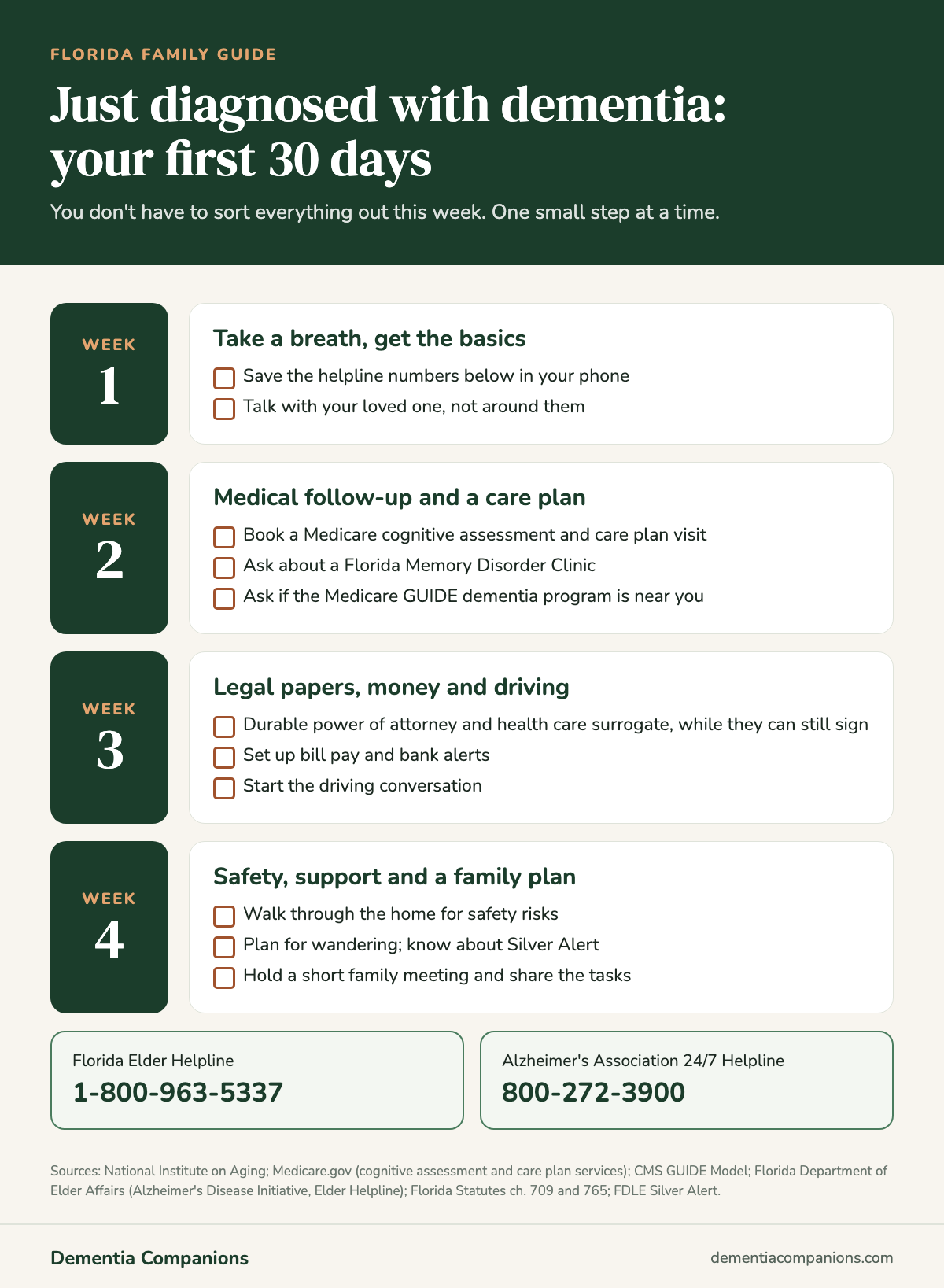
If your parent or spouse was just diagnosed, you probably left the doctor’s office with more questions than answers. That is normal. You do not have to sort everything out this week. The checklist below breaks the first 30 days into small, doable steps for Florida families, with the phone numbers and offices that can help.
Week 1: Take a breath and get the basics in place
The first week is about absorbing the news and gathering information. Nobody needs to make big decisions yet.
Let feelings be part of the plan
The Alzheimer’s Association notes that people who are newly diagnosed often feel anger, denial, fear or sadness, and that there is no single right way to handle it. Family members feel these things too. If low mood or worry lasts for weeks, for your loved one or for you, mention it to a doctor, because treatment for depression or anxiety can help.
- ☐ Ask the doctor for the diagnosis in writing, including the type of dementia if it is known.
- ☐ Start one notebook or shared document for appointments, medications, questions and contacts.
- ☐ Save the Alzheimer’s Association Helpline in your phone: 800-272-3900. You can call any time, day or night, to talk through what you are feeling or what to do next.
- ☐ Save the Florida Elder Helpline: 1-800-963-5337 (1-800-96-ELDER). It connects you to elder services in your county.
- ☐ Read a plain-language overview of how dementia changes over time, such as our guide to the stages of dementia, so you know what may come next.
Talk with your loved one, not around them
Early on, many people with dementia can still say what matters to them: who they trust, where they want to live, how they feel about driving. Ask. Write down what they say. Those wishes will guide many later choices, and asking now shows respect.
Week 2: Medical follow-up and a care plan
A diagnosis is a starting point. The next step is a plan.
Book a care planning visit
Medicare Part B covers a separate visit with a doctor or other health care provider to review cognitive function, confirm a diagnosis like dementia or Alzheimer’s disease, and build a care plan. During that visit the provider may review medications and medical history, look at what support and caregiving is available, refer you to specialists, help update advance care planning documents and point you to community resources such as support groups. You can bring someone with you. After the Part B deductible, you usually pay 20% of the Medicare-approved amount.
- ☐ Call the doctor’s office and ask for a “cognitive assessment and care plan” visit.
- ☐ Bring a full list of medications, including vitamins and over-the-counter products.
- ☐ Go with your loved one, take notes, and bring the questions in the list below.
- ☐ Keep up with the rest of their health care too. The National Institute on Aging (NIA) advises regular visits with the primary care doctor and any recommended specialists, and not ignoring other health problems.
Ask about a Florida Memory Disorder Clinic
Florida’s Alzheimer’s Disease Initiative, run by the Department of Elder Affairs, funds 17 Memory Disorder Clinics across 13 service areas. They offer diagnostic services and education for caregivers. NIA also suggests asking your doctor for a referral to a memory disorders clinic. Call the Elder Helpline or ask the doctor which clinic serves your area.
Ask about the GUIDE dementia program
Medicare is running a dementia care model called GUIDE, which started July 1, 2024 and is set to run for eight years. Participating programs offer care navigation, a support line that is open 24 hours a day, caregiver training and support, and up to $2,500 a year in respite care for eligible people. To be eligible, a person generally must have a dementia diagnosis, be in Original Medicare Parts A and B (not Medicare Advantage or PACE), not live in a long-term nursing home and not be in hospice. Not every area has a participating program, so ask your doctor, or check the participant list on the CMS GUIDE page.
Questions to ask the doctor
- What type of dementia is this, and how sure are you?
- Which tests did you use, and do we need any more?
- What treatment options are available, and what are the side effects?
- Should any current medications be changed or stopped?
- What changes should we watch for over the next few months?
- Is it safe for them to drive, cook, manage money or stay alone right now?
- Can you refer us to a Memory Disorder Clinic, a specialist or a GUIDE program?
- Are there clinical trials we might qualify for?
- What support services can help them live well at home?
Week 3: Legal papers, money and driving
This is the week many families put off, and the one that matters most to do early. Legal planning works best while your loved one can still understand and sign documents. We are not lawyers, and this is not legal advice. A Florida elder law attorney can tell you what fits your family. Our legal and financial planning guide covers this in more depth.
Two Florida documents to ask an attorney about
- ☐ Durable power of attorney (Florida Statutes, chapter 709). This names someone to handle money and property. Florida requires it to be signed by the person and two witnesses and acknowledged before a notary. “Durable” means it keeps working if the person later loses capacity, and the document has to say so.
- ☐ Health care surrogate designation (Florida Statutes, chapter 765). This names someone to make health care decisions or receive health information. It must be signed in front of two adult witnesses. The person named as surrogate cannot be a witness, and at least one witness must not be the spouse or a blood relative. You can also name an alternate.
- ☐ Ask the attorney about a will and a living will at the same visit. NIA recommends preparing or updating a will, living will, health care power of attorney and financial power of attorney after a diagnosis.
- ☐ Make copies, and give the doctor’s office a copy of the health care surrogate form.
Get a handle on money
- ☐ List bank accounts, bills, insurance policies, pensions and passwords in one safe place.
- ☐ Watch for missed bills, unusual charges and scam calls.
- ☐ If your loved one still works, NIA suggests talking with the employer’s human resources office or employee assistance program about family leave, disability and other benefits.
- ☐ Learn what help Florida offers. Our page on Florida programs that help pay for dementia care explains the options.
One program to know about is the Statewide Medicaid Managed Care Long-Term Care (SMMC LTC) program. It is for people 65 and older who are eligible for Medicaid (or 18 and older and eligible because of a disability) and who are found to need a nursing home level of care. You start by contacting your local Aging and Disability Resource Center (ADRC) through the Elder Helpline. There may be a waitlist, so ask the ADRC about it.
Have the driving conversation
A diagnosis does not automatically end driving, but it does mean watching closely. Ask the doctor directly whether driving is still safe. If it is not and your loved one keeps driving, Florida law lets any physician, person or agency report a driver who may not be able to drive safely to the Florida Department of Highway Safety and Motor Vehicles (FLHSMV) for medical review. The state uses a Medical Referral Form (HSMV 72190), and these reports are confidential and cannot be used as evidence in court.
- ☐ Ask the doctor about driving safety at the care plan visit.
- ☐ Ride along a few times and note any close calls, getting lost or new dents.
- ☐ Line up other rides before you ask them to stop. Our guide on when and how to stop driving with dementia has scripts that help.
Week 4: Safety, support and a plan for the family
Make home safer
NIA suggests small changes at home, like nonslip rugs, so daily tasks are easier and safer. Simple memory aids help too: notes for reminders, a pillbox for medications and a calendar for appointments.
- ☐ Walk through the home for trip hazards, poor lighting and slippery bathroom floors.
- ☐ Set up a weekly pill organizer and a large wall calendar.
- ☐ Check the stove, medications, firearms and pool or lake access. Our Florida dementia home safety guide has a room-by-room checklist.
Plan for wandering and know about Silver Alert
The Alzheimer’s Association says six in ten people living with dementia will wander at least once, and many do so more than once. It recommends keeping a current close-up photo ready for police, thinking about a wandering response service, noting nearby risks such as water and busy roads, and asking neighbors to keep an eye out.
Florida has a Silver Alert plan to help find missing older adults with dementia or a similar condition, especially when they leave by car. If your loved one goes missing, call 911 or local law enforcement right away. Police decide whether an alert is issued, and a license plate number and vehicle description help.
- ☐ Take a clear, recent photo and save it on your phone.
- ☐ Write down the car’s make, model, color and plate number.
- ☐ Make a list of places your loved one might try to go.
Find support for yourself
- ☐ Call the Elder Helpline (1-800-963-5337) to ask about caregiver support, respite and services in your county. Florida’s Alzheimer’s Disease Initiative offers respite options, including in-home care.
- ☐ Look for a caregiver support group through the Alzheimer’s Association or your local ADRC.
- ☐ Browse our list of Florida dementia resources by region.
Get the family on the same page
Caregiving goes better when one person is not doing it all. Hold a short family meeting, in person or by video. Share what the doctor said, divide tasks (appointments, bills, weekly visits) and agree on how you will keep each other updated. If that talk feels hard, our guide to talking to siblings about dementia care can help you plan it.
Think about day-to-day help at home
Many families find that, early on, the biggest need is not medical care but company: someone to share a meal, go for a walk, keep a routine going and give the main caregiver a break. That is what Dementia Companions does. We match Florida families with companion caregivers who are screened for dementia care experience. You watch video interviews and choose the person who fits. Every companion completes Florida’s ADRD (Alzheimer’s disease and related dementias) training before the first visit. This is companion care, not medical or home health care. If you would like to see how it works, read our family guide or call us at (786) 432-5758.
Frequently asked questions
What should I do first after a dementia diagnosis in the family?
Start with three calls: book a follow-up visit with the doctor to get a care plan, call the Florida Elder Helpline at 1-800-963-5337 to learn about local services, and contact an elder law attorney about a durable power of attorney and a health care surrogate. Everything else can follow over the next few weeks.
Does Medicare pay for dementia care planning?
Yes. Medicare Part B covers a cognitive assessment and care plan visit. After the Part B deductible you usually pay 20% of the Medicare-approved amount. If your loved one has Original Medicare, also ask whether a GUIDE dementia program serves your area.
Can someone with dementia still sign a power of attorney in Florida?
Often yes, especially in the early stage, but it depends on whether they understand what they are signing. That is why acting soon matters. Only a Florida attorney can advise on your situation, so book that appointment early.
Does a dementia diagnosis mean they have to stop driving?
Not automatically. The question is whether they can still drive safely, and the doctor is the best person to ask. If there are real safety concerns, anyone can send a confidential medical review report to FLHSMV.
How fast will the dementia get worse?
It varies a lot by person and by type of dementia, so ask the doctor what to expect in your loved one’s case. Planning early gives you more choices later.
Still have questions?
Talk it through with us. A free call about your family's situation, with no obligation.
Call (689) 333-6079Send us a message- Screened for dementia care experience
- Florida ADRD training before the first visit
Sources
- National Institute on Aging, Steps to Take After a Dementia Diagnosis: https://www.nia.nih.gov/health/alzheimers-and-dementia/steps-take-after-dementia-diagnosis
- National Institute on Aging, Next Steps After an Alzheimer’s Diagnosis: https://www.nia.nih.gov/health/alzheimers-treatment/next-steps-after-alzheimers-diagnosis
- Alzheimer’s Association, Just Diagnosed: https://www.alz.org/help-support/i-have-alz/know-what-to-expect/just-diagnosed
- Alzheimer’s Association, Wandering: https://www.alz.org/help-support/caregiving/stages-behaviors/wandering
- Medicare.gov, Cognitive assessment and care plan services: https://www.medicare.gov/coverage/cognitive-assessment-care-plan-services
- CMS, Guiding an Improved Dementia Experience (GUIDE) Model: https://www.cms.gov/priorities/innovation/innovation-models/guide
- Florida Department of Elder Affairs, Alzheimer’s Disease Initiative: https://elderaffairs.org/programs-and-services/alzheimers-disease-initiative-adi/
- Florida Department of Elder Affairs, Elder Helpline: https://elderaffairs.org/resource-directory/elder-helpline/
- Florida Department of Elder Affairs, SMMC Long-Term Care Program: https://elderaffairs.org/programs-and-services/statewide-medicaid-managed-care-long-term-care-program/
- FLHSMV, Medical Review: https://flhsmv.gov/driver-licenses-id-cards/medical-review/
- FLHSMV, Medical Referral Form HSMV 72190: https://www.flhsmv.gov/pdf/forms/72190.pdf
- Florida Statutes 322.126, Report of disability to department: https://www.flsenate.gov/Laws/Statutes/2025/322.126
- Florida Statutes 709.2104 and 709.2105, Durable power of attorney: https://www.flsenate.gov/Laws/Statutes/2025/709.2105
- Florida Statutes 765.202, Designation of a health care surrogate: https://www.flsenate.gov/Laws/Statutes/2025/765.202
- Florida Department of Law Enforcement, Silver Alert: https://www.fdle.state.fl.us/amber-plan/silver-alert
Want a companion screened for dementia care experience?
We'll send 3-5 caregiver video profiles within 48 hours, so you can watch their video interviews before you decide. $35/hour for 40+ hours a week, no contracts.