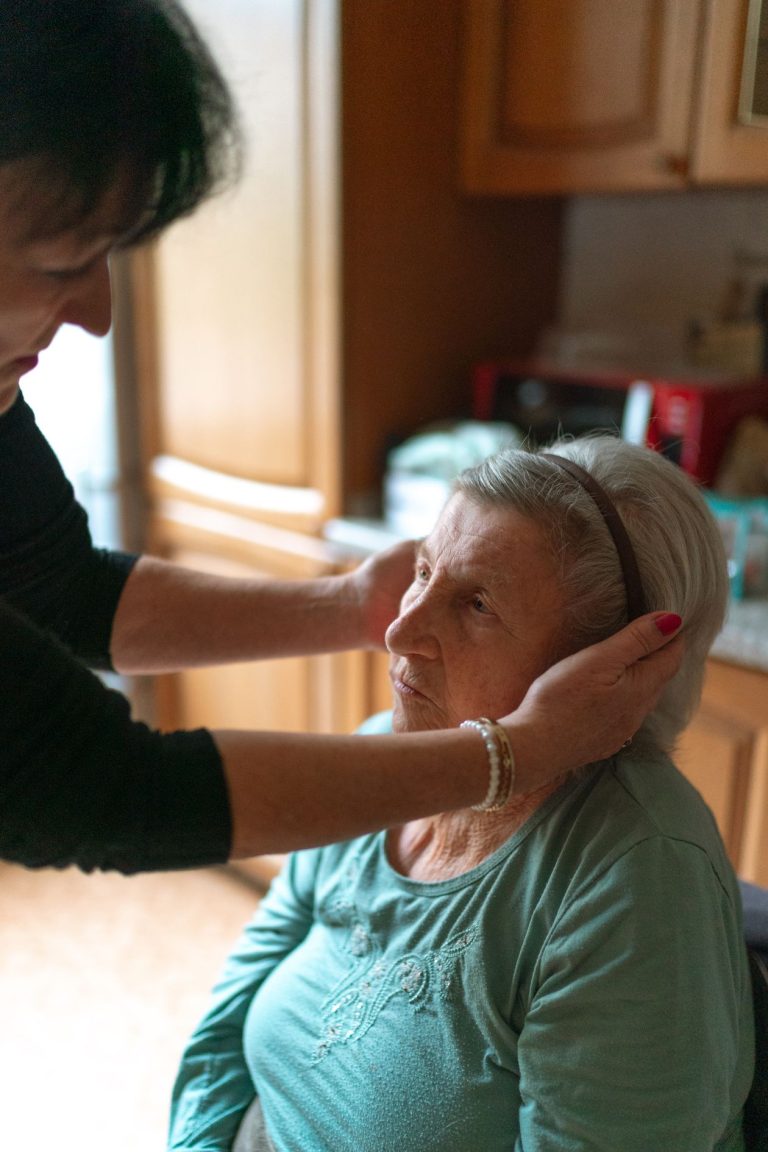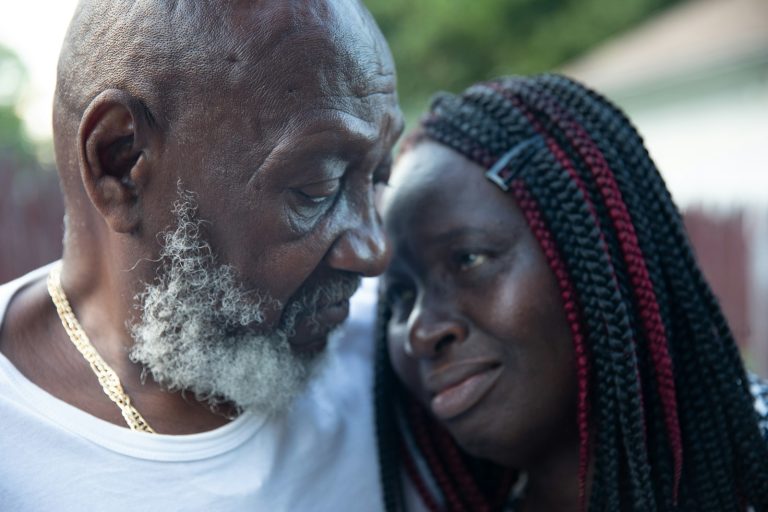
To communicate with a loved one who has dementia once words get hard, slow down, use short sentences and yes-or-no questions, and lean on tone, touch, and facial expression. In the middle and later stages, the feeling behind what your loved one says often matters more than the exact words, and calm reassurance reaches them long after detailed conversation fades.
This guide focuses on dementia communication problems in the stages when speech gets harder, including word-finding problems and aphasia. You will find phrases to use and avoid, a stage-by-stage table, ideas for nonverbal connection, and Florida-specific notes for bilingual families.
Table of contents
Why communication changes
Dementia damages the parts of the brain that handle language, memory, and attention. This is the disease, not stubbornness.
The National Institute on Aging describes common struggles: finding the right word, understanding what words mean, keeping a train of thought, following long conversations, and blocking out background noise from the TV or radio.
Many families notice their loved one describing an object instead of naming it (“the thing you drink from”), repeating a familiar phrase, or losing track mid-sentence. Over time, speech may shrink to a few words or sounds. The medical term for this kind of language loss is aphasia.
A note for bilingual Florida families
The NIA notes that some people lose a language learned later in life and return to their first language, such as Spanish. In Miami, Tampa, and Orlando this is common. If your loved one starts answering in Spanish, Haitian Creole, Portuguese, or Yiddish, follow their lead. A helper who speaks that language can make a real difference.
How to communicate with a loved one who has dementia, stage by stage
Communication needs shift as dementia progresses. The Alzheimer’s Association describes how approaches change across stages; this table summarizes them in plain terms.
| Stage | What you may notice | What helps |
|---|---|---|
| Early | Word-finding pauses, repeated stories | Include them, give time, ask what they need |
| Middle | Lost train of thought, trouble with questions | Quiet room, one question at a time, yes-or-no choices |
| Late | Few words, sounds, facial expressions | Approach from the front, touch, music, focus on feelings |
Stages overlap, and good days and hard days come and go. Use whatever works today.

Phrases and approaches that help
Small changes to how you speak can lower frustration for both of you.
Set up the moment
Turn off the TV, sit at eye level, and make eye contact. Say your loved one’s name and your own: “Hi Mom, it’s Ana.” That simple greeting spares them the stress of guessing.
Keep sentences short
One idea per sentence. “Let’s have lunch” works better than “Let’s finish this, wash up, and then have lunch before your sister calls.” Give instructions one step at a time and show what you mean.
Offer choices, not open questions
The NIA suggests swapping “What do you want for dinner?” for “Fish or chicken?” and “How do you feel?” for “Are you feeling sad?” If they do not understand, rephrase with different words rather than repeating louder.
Wait
Count slowly to ten before stepping in. Silence is fine. Jumping in too fast can make your loved one give up trying.
Answer the feeling
If your father asks for his own mother, he may be feeling unsafe. “You miss her. Tell me about her” meets the need without a painful correction.
Quick swaps: instead of this, try that
Keep this short list on the fridge for every family member and helper.
| Instead of | Try |
|---|---|
| “You already asked me that.” | “Good question. We’re going at two.” |
| “Don’t you remember?” | “I remember that trip. You loved the beach.” |
| “What do you want to wear?” | “Blue shirt or green shirt?” |
| “Your husband died years ago.” | “You’re thinking about him. Tell me about him.” |
| “Hurry up, we’re late.” | “Let’s put on your shoes. Here’s the first one.” |
The goal is to keep your loved one’s dignity intact while still getting through the day.
Repeated questions
Repeating the same question is common and usually signals worry, not forgetfulness alone. Answer calmly each time, and try a written note or a whiteboard with the answer (“Lunch with Carmen at noon”). If the question keeps coming, look for the feeling underneath it, such as fear of being left alone.
Help others communicate too
Doctors, nurses, and new helpers do not know your loved one’s cues. A one-page sheet listing their preferred name, language, hearing needs, favorite topics, and signs of pain helps everyone. Our free hospital information sheet is a ready-made template.
What to avoid
Some habits, however loving, make communication harder.
- Quizzing. “Do you remember who this is?” feels like a test they are failing.
- Arguing with their reality. Insisting on the date rarely helps and often upsets.
- Baby talk. The NIA cautions against a “baby voice.” Speak as one adult to another.
- Talking about them in front of them. Assume they understand more than they can say.
- Rushing. Hurry shows in your voice and body even when your words are kind.
When frustration builds, take a breath, step away briefly, and try again.
When words fail, connection does not
As speech fades, your loved one relies more on nonverbal signals, and so can you.
- Touch. A held hand or a hand on the shoulder can say “you’re safe” better than a sentence.
- Music. Familiar songs often reach people when speech does not. See our guide to using music to connect.
- Photos and objects. A wedding photo or a favorite tool can start a “conversation” without words.
- Your face. A relaxed smile and soft eyes signal calm.
Watch their face and body for messages too. Grimacing, pulling at clothes, or pacing may mean pain, hunger, a full bladder, or boredom.
Reading behavior as communication
When someone cannot say “I hurt” or “I’m scared,” the message often comes out as restlessness or anger. Our guide to agitation and aggression explains how to look for the cause behind the behavior.
Example: an afternoon visit that works
This is an illustrative example, not a real family. A son in Coral Gables visits his mother, who now speaks mostly in short phrases and sometimes switches to Spanish.
- He turns off the TV and sits beside her, saying, “Hola, Mamá, it’s Luis.”
- He brings a photo of her garden and asks, “Roses or orchids?”
- When she struggles for a word, he waits, then offers a guess: “The yellow ones?”
- He plays a bolero she loves and holds her hand.
The visit is quiet and short, but she smiles and squeezes his hand. That counts as a good conversation.
When to talk to the doctor
Gradual change in speech is expected with dementia. Sudden change is not. Call your loved one’s doctor if speech changes quickly over hours or days, or if new confusion appears, since infections and medication effects can cause sudden problems.
Call 911 right away for sudden slurred speech, a drooping face, or weakness on one side, which can be signs of a stroke. Also ask the doctor about hearing and vision checks; the Alzheimer’s Association notes that hearing aids or glasses can make communication easier.
This article is general information, not medical advice.
Frequently asked questions
What is the best way to talk to someone with late-stage dementia?
Approach from the front, say who you are, and speak slowly in a calm, warm voice. Use touch, music, and familiar objects. Focus on the feeling behind any sounds or words, and never talk as if your loved one is not there.
Why does my loved one keep switching to Spanish?
Dementia can affect a language learned later in life before a first language. Many people return to the language of their childhood. Answer in that language if you can, and look for helpers who speak it.
Should I correct my loved one when they say something wrong?
Usually not. Correcting rarely restores memory and often causes embarrassment or anger. Respond to the emotion instead, and gently redirect if needed. Correct only when safety is at stake.
What is aphasia in dementia?
Aphasia is a loss of the ability to understand or express language. In dementia it often starts with word-finding pauses and may progress to very few words. Communication through tone, touch, and expression remains possible.
How can a companion help with dementia communication problems?
A consistent companion learns your loved one’s cues, favorite topics, and calming routines over time. Familiarity makes conversation easier, and families get a brief note after each visit about mood and engagement.
Still have questions?
Talk it through with us. A free call about your family's situation, with no obligation.
Call (689) 333-6079Send us a message- Screened for dementia care experience
- Florida ADRD training before the first visit
Conclusion
When words get hard, you can still communicate with a loved one who has dementia. Short sentences, simple choices, patience, and attention to feelings carry most conversations, and touch and music fill the gaps.
Expect good days and hard days. Keep what works, let go of what does not, and talk to the doctor about any sudden change.
If you would like a patient, consistent companion to share the conversation, get 3 free caregiver profiles within 48 hours or call (689) 333-6079. Explore our memory and engagement visits, available across Florida for $35 an hour for 40+ hours a week.
Want a companion screened for dementia care experience?
We'll send 3-5 caregiver video profiles within 48 hours, so you can watch their video interviews before you decide. $35/hour for 40+ hours a week, no contracts.