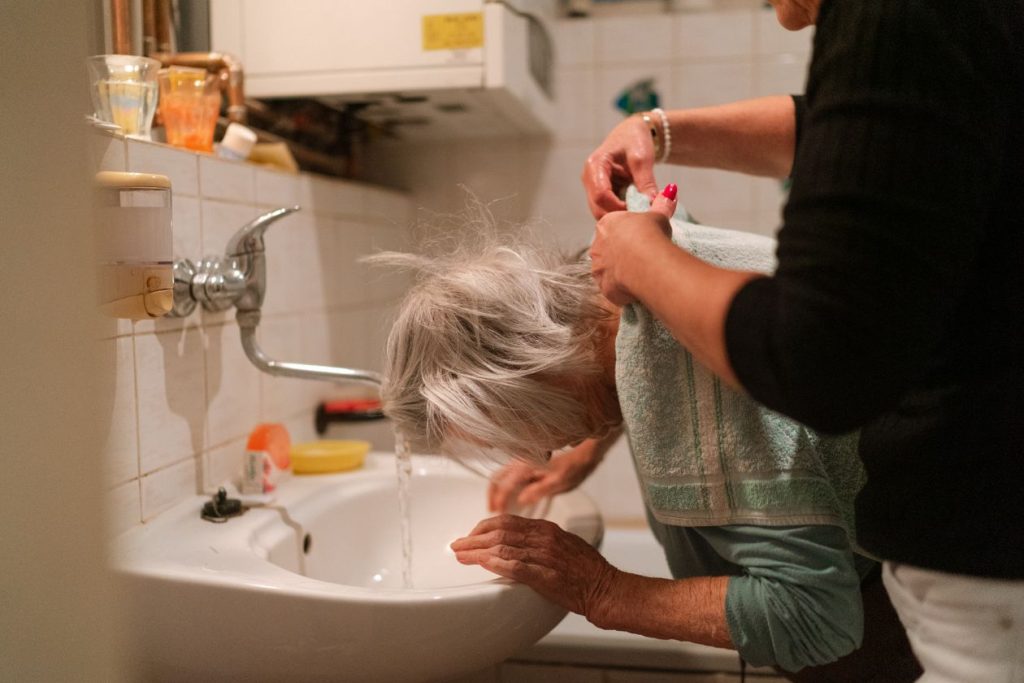
Dementia and incontinence often go together as the disease progresses, because your loved one may stop noticing the urge, forget where the bathroom is or struggle with clothing. A regular bathroom schedule, easy clothing, a clearly marked bathroom, steady daytime fluids and a calm, respectful tone prevent many accidents. Always rule out treatable causes with the doctor first.
This guide explains why incontinence happens, how to build a gentle toileting routine, why cutting fluids backfires in Florida’s heat, how to protect skin and dignity, and when to get medical help. It is written for families who want practical answers without embarrassment.
Table of contents
Why dementia and incontinence often go together
Incontinence in dementia is rarely just a bladder or bowel problem.
The National Institute on Aging, in its guide to common medical problems in Alzheimer’s, says most people with Alzheimer’s will experience incontinence at some point, more often in the later stages. Accidents can happen because the person has trouble finding the bathroom or recognizing the toilet. The Alzheimer’s Association adds that hard-to-find bathrooms, cluttered or dark paths and clothing that is hard to remove all contribute. See its page on incontinence.
Treatable causes to rule out
Both organizations list medical causes that a doctor may be able to treat:
- Urinary tract infections
- Constipation
- Prostate problems
- Diabetes
- Side effects of medicines, such as some sleeping pills and anti-anxiety drugs
- Caffeine in coffee, tea and cola
If accidents start suddenly, see the doctor before assuming the dementia has advanced.

Building a gentle toileting routine
A predictable schedule prevents more accidents than waiting for your loved one to ask.
Plan bathroom trips
The NIA suggests reminding the person to use the bathroom every two to three hours and showing them the way. The Alzheimer’s Association recommends tracking when accidents happen and scheduling trips just before those times.
Watch for signals
Restlessness, pacing, tugging at clothes or suddenly getting up can all mean “I need to go.” Learn your loved one’s own words for the bathroom, too.
Use simple cues
“Let’s go to the bathroom now” is easier to follow than “Do you need to go?” Offer one step at a time.
Sample daily toileting schedule
| Time | Toileting | Fluids |
|---|---|---|
| On waking | Bathroom first thing | Glass of water with breakfast |
| Mid-morning | Before an outing or activity | Sips through the morning |
| After lunch | Bathroom after the meal | Water or milk with lunch |
| Mid-afternoon | Before a rest or walk | Water-rich snack like watermelon |
| After dinner | Bathroom after the meal | Smaller amounts after 6 p.m. |
| Bedtime | Last trip before bed | Fruit instead of drinks if thirsty |
Adjust times to your loved one’s own pattern.
Make the bathroom easy to find and use
- Keep the bathroom door open and mark it with a big “Toilet” sign or picture.
- Use a colored toilet seat so it stands out.
- Add night lights along the path from bed to bathroom.
- Install grab bars and a raised seat if needed.
- Consider a bedside commode for nighttime.
Our room-by-room home safety guide covers bathroom safety in more detail.
Choose easy clothing
Elastic waistbands are easier than buttons, zippers and belts. See our guide to making dressing easier for more ideas.
Hydration in Florida: don’t cut fluids
It is tempting to cut back on drinks to reduce accidents. The Alzheimer’s Association warns that limiting fluids can cause dehydration, which can lead to urinary tract infections and more incontinence. In Florida’s heat, dehydration can also cause dizziness and sudden confusion.
- Offer small drinks steadily through the day.
- Serve water-rich foods such as watermelon, oranges and soups.
- Limit caffeine, which irritates the bladder.
- If nights are the problem, the NIA suggests limiting fluids after 6 p.m.
Read more in our guide to preventing dehydration in Florida’s summer.
Bowel incontinence and constipation
Bowel accidents are often linked to constipation, which is common in older adults and easy to miss when someone cannot describe discomfort. Hard stool can block the bowel, and loose stool can leak around it.
The NIA suggests high-fiber foods such as prunes, raisins, dried apricots and whole-grain bread, enough fluids and some physical activity, like a daily walk. Keep a simple note of bowel movements, and tell the doctor about any change in habits.
Managing nighttime accidents
Nights are often the hardest part of dementia and incontinence, for both of you.
- Taper drinks in the evening and avoid caffeine after lunch.
- Guide your loved one to the bathroom right before bed.
- Light the path with night lights or motion-sensor lights.
- Use a waterproof mattress cover and washable bed pads.
Overnight briefs can help some people sleep through the night. Ask the doctor if nighttime accidents start suddenly.
Protecting dignity during accidents
How you respond matters as much as the routine. Your loved one may feel ashamed even if they cannot say so.
- Stay matter-of-fact: “Anyone can have an accident. Let’s get you comfortable.”
- Use adult words such as “underwear” or “briefs,” not “diaper.”
- Never scold. Accidents are the disease, not a choice.
- Keep it private and brief.
Keep a small kit of wipes, gloves, a change of clothes and bags in the car and by the bed.
Skin care
The NIA recommends cleaning the skin after every leak with mild soap, rinsing, letting it air dry if possible and then applying a moisturizer or petroleum jelly. Our guide to caring for fragile skin explains what to watch for.
Example: nights in Boca Raton
This is an illustrative scenario, not a real family. A husband cares for his wife, who has moderate dementia. She was waking wet most nights, and he was exhausted from changing sheets.
First, her doctor checked for a urinary tract infection; the test was clear. Then he changed small things. He moved her afternoon iced tea to decaf, offered most drinks before 6 p.m., and added a night light and a sign on the bathroom door.
He guides her to the bathroom right before bed and once when he wakes around 2 a.m. He uses a waterproof mattress cover and keeps a fresh nightgown on the dresser. Accidents still happen, but much less often, and both of them sleep better.
When to see the doctor
The Alzheimer’s Association says the first and most important step when someone recently starts losing bladder or bowel control is to see a doctor.
Call promptly for sudden incontinence, burning, fever, blood in the urine, sudden new confusion, constipation lasting several days or skin that is broken or red. These can signal an infection or another treatable problem. Our guide to UTIs and delirium explains the warning signs. This article is general information, not medical advice.
Frequently asked questions
At what stage of dementia does incontinence start?
It can happen at any stage, but it is more common in the later stages. A sudden change in any stage should be checked by a doctor, since infections, constipation and medicines can be the cause.
Should I limit fluids to prevent accidents?
No. Limiting fluids can lead to dehydration and urinary tract infections, which can make incontinence worse. Offer drinks steadily during the day and taper them in the evening if nighttime accidents are a problem.
How often should someone with dementia be taken to the bathroom?
The NIA suggests reminders every two to three hours. Tracking your loved one’s pattern for a few days lets you schedule trips just before accidents tend to happen.
How can I talk about incontinence without embarrassing my parent?
Keep it brief and matter-of-fact, use adult words and handle it privately. A calm “Let’s get you freshened up” protects dignity better than any long explanation.
What supplies make incontinence easier to manage?
Many families keep adult disposable briefs or underwear, washable bed protectors, waterproof mattress covers, gentle wipes, gloves, a barrier cream and a spare set of clothes. A bedside commode and night lights help at night. Ask the doctor or a continence nurse which products fit your loved one best.
Still have questions?
Talk it through with us. A free call about your family's situation, with no obligation.
Call (689) 333-6079Send us a message- Screened for dementia care experience
- Florida ADRD training before the first visit
Conclusion
Dementia and incontinence can feel overwhelming, but a steady routine makes a real difference. Rule out treatable causes, schedule bathroom trips, make the bathroom easy to find, keep fluids up during the day and respond to accidents with calm and respect.
Protect the skin, and ask for help before exhaustion sets in. Our comparison of companion care vs. home health care explains which support fits which need.
For routine, reminders and respite, get 3 free caregiver profiles within 48 hours or call (689) 333-6079. Our dementia respite care is $35 an hour for 40+ hours a week, with no long-term contract.
Want a companion screened for dementia care experience?
We'll send 3-5 caregiver video profiles within 48 hours, so you can watch their video interviews before you decide. $35/hour for 40+ hours a week, no contracts.