
Oral care and dementia go together more than many families realize. As memory changes, your loved one may forget how or why to brush, and may not be able to tell you when a tooth hurts. A calm routine twice a day, simple step-by-step cues, daily denture care and regular checks of the mouth can prevent pain, infection and eating problems.
This guide to oral care for dementia covers why mouth health matters, how to make brushing easier, denture and dry mouth care, warning signs of mouth pain and how to prepare for the dentist. It is written for Florida families who want practical steps that fit into an already full day.
Table of contents
Why oral care and dementia matter together
A healthy mouth helps your loved one chew, eat and enjoy food. It also prevents pain that they may not be able to describe.
The Alzheimer’s Association notes that good dental care helps people with dementia avoid mouth infections and eating or digestion problems, and can reduce the need for more complex dental work later. Over time, a person may forget how to brush or why it matters, so caregivers often need to take a more hands-on role. Its page on dental care is a helpful reference.
Pain that shows up as behavior
When the mouth hurts, many people with dementia cannot say so. Instead, you may see refusing food, wincing during meals, pulling at the face, new restlessness or poor sleep. Our guide to recognizing pain in dementia explains other signs.

Making daily brushing easier
Brushing does not have to be a battle. Aim for twice a day, with the last cleaning after the final meal or drink of the evening.
Set up for success
- Pick a calm time of day. For many people, that is mid-morning.
- Brushing does not have to happen at the bathroom sink. A comfortable chair at the kitchen table works too.
- Have your loved one sit upright with a towel over their chest.
- Use a soft children’s toothbrush or one with a long or angled handle.
Wash your hands or wear gloves before you help.
Use one-step cues
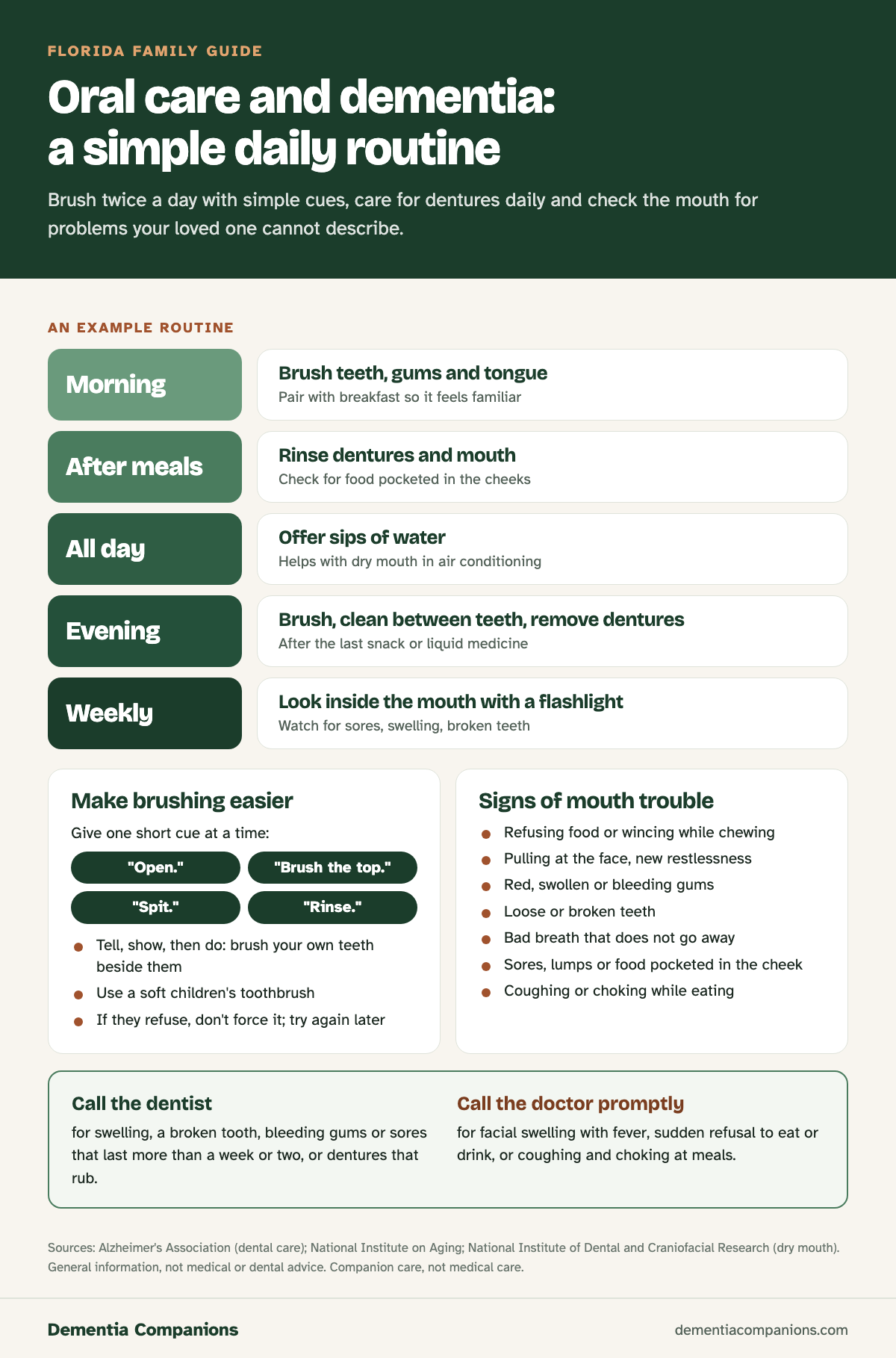
Give one short instruction at a time: “Open.” “Brush the top.” “Spit.” “Rinse.” Long sentences are hard to follow.
Show, then guide
The Alzheimer’s Association describes a “tell-show-do” approach: explain the step, demonstrate it on yourself, then let your loved one try. Brushing your own teeth beside them often works better than instructions. If needed, gently guide their hand with yours.
Protect independence
Let your loved one do as much as they can, even if it is not perfect. You can finish the hard-to-reach spots afterward. Praise the effort.
When they refuse
Do not force it. Step back, stay pleasant and try again in fifteen minutes or at another time of day. Our article on responding to care refusal has more ideas.
A simple daily oral care routine
Here is an example routine you can adapt. Your loved one’s dentist may suggest changes.
| Time | Task | Tip |
|---|---|---|
| Morning | Brush teeth, gums and tongue | Pair with breakfast so it feels familiar |
| After meals | Rinse dentures and mouth | Check for food pocketed in the cheeks |
| Through the day | Offer sips of water | Helps with dry mouth in air conditioning |
| Evening | Brush, clean between teeth, remove dentures | Do this after the last snack or liquid medicine |
| Weekly | Look inside the mouth with a flashlight | Watch for sores, swelling, broken teeth |
Keep supplies in one basket so everything is ready.
Caring for dentures
Dentures need daily care too. The Alzheimer’s Association recommends rinsing them after meals, brushing them daily, removing and soaking them at night, and cleaning the gums with a soft brush or moist gauze.
- Use a denture brush and denture cleaner rather than regular toothpaste, unless the dentist says otherwise.
- Check the fit. Weight loss and gum changes can make dentures loose and cause sores.
- Label the denture case, especially for respite stays, hospital visits or adult day programs.
If dentures go missing often, check pockets, napkins and trash cans before meals are cleared.
Managing dry mouth in Florida
Dry mouth is common in older adults, and many medicines can cause it. The National Institute of Dental and Craniofacial Research lists medicines for high blood pressure, depression and bladder control among common causes. Saliva protects teeth, so less of it means a higher risk of decay and mouth infections. See NIDCR’s page on dry mouth.
- Offer sips of water often, especially in summer and in strongly air-conditioned rooms.
- Use a humidifier at night if the bedroom air is dry.
- Limit caffeine and avoid alcohol-based mouthwash.
- Keep lips moisturized with a balm.
Ask the dentist or pharmacist about saliva substitutes. Avoid hard candies if your loved one has any trouble swallowing, since they can be a choking risk.
Warning signs to watch for
The NIA suggests regular checks of the mouth for sores and lumps, tooth decay and food pocketed in the cheek or on the roof of the mouth. Also watch for:
- Red, swollen or bleeding gums
- Loose or broken teeth
- Bad breath that does not go away
- New refusal to eat, or wincing while chewing
Coughing or choking while eating can point to swallowing problems. Read our guide to dysphagia and dementia and tell the doctor.
Making dentist visits easier
Keep up regular dental visits for as long as your loved one can manage them.
- Tell the office about the dementia diagnosis when you book.
- Ask for an early, short appointment at a quiet time.
- Bring a list of medicines and doctors.
- Share what works at home, such as a favorite song or a calming phrase.
- Bring a comfort item and a snack for afterward.
Our guide to making doctor visits easier has more tips that apply to the dentist, too. If visits become impossible, the Alzheimer’s Association suggests focusing on good care at home.
Example: a morning routine in Delray Beach
This is an illustrative scenario, not a real family. A wife cares for her husband, who has middle-stage Alzheimer’s. Evenings were a struggle: he was tired and pushed the toothbrush away.
She moved the main brushing to 10 a.m., after breakfast, at the kitchen table. She sets out a towel, a soft children’s brush and a cup of water, then brushes her own teeth beside him while humming. She says one word at a time: “Open.” “Top.” “Spit.” He brushes the front teeth himself and she finishes the back.
At night she does a quick rinse and removes his partial denture. On Sundays she checks his gums with a flashlight. Within a few weeks, brushing takes five minutes instead of a standoff.
When to call the dentist or doctor
Call the dentist if you see swelling, a broken tooth, bleeding gums or sores that last more than a week or two, or if dentures rub. Call the doctor promptly for facial swelling with fever, sudden refusal to eat or drink, or coughing and choking at meals. This article is general information, not medical or dental advice.
Frequently asked questions
How often should someone with dementia brush their teeth?
At least twice a day, cleaning the teeth, gums and tongue. The final brushing should come after the last meal, snack or liquid medicine of the day. Clean between the teeth daily if possible, using interdental brushes or a water flosser if floss is too hard.
What if my loved one won’t open their mouth?
Stop and try again later. Sit at eye level, smile, demonstrate on yourself and give one simple cue. A soft brush, a familiar song or a different room can help. Never force the mouth open.
Should dentures be removed at night?
Generally yes. The Alzheimer’s Association recommends removing and soaking dentures at night and cleaning the gums. Ask the dentist if your loved one has a special situation.
Can mouth pain cause behavior changes?
Yes. Pain from a tooth, sore or loose denture may show up as refusing food, agitation, face rubbing or poor sleep. If behavior changes suddenly, check the mouth and talk with the dentist or doctor.
Can a companion help with oral care for dementia?
A companion can offer reminders, set out supplies, model brushing and keep the routine consistent during visits. They can also share notes about any changes they notice so you can follow up with the dentist.
Still have questions?
Talk it through with us. A free call about your family's situation, with no obligation.
Call (689) 333-6079Send us a message- Screened for dementia care experience
- Florida ADRD training before the first visit
Conclusion
Oral care and dementia call for patience, routine and a soft touch. Brush twice a day with simple cues, care for dentures daily, ease dry mouth and check the mouth regularly for problems your loved one cannot describe.
Small steps add up to real comfort, better meals and fewer painful surprises.
If you would like help keeping daily routines steady, get 3 free caregiver profiles within 48 hours or call (689) 333-6079. Our in-home support visits are $35 an hour for 40+ hours a week, with no long-term contract.
Want a companion screened for dementia care experience?
We'll send 3-5 caregiver video profiles within 48 hours, so you can watch their video interviews before you decide. $35/hour for 40+ hours a week, no contracts.