Apathy and withdrawal in dementia are a loss of motivation and interest caused by changes in the brain, not laziness or stubbornness. Your loved one may sit for hours, shrug at invitations and stop hobbies they loved. Starting activities alongside them, breaking tasks into tiny steps, leaning on lifelong interests and ruling out depression, hearing loss or illness can help them re-engage.
This guide explains what apathy in dementia is, how it differs from depression, other causes worth checking, practical ways to spark engagement, and how to protect your own spirits when the person you love seems far away.
Table of contents
What apathy and withdrawal in dementia look like
Many families describe a moment when a parent or spouse who was always busy in the garden, quick with a phone call or first to the card table simply stops. They watch television without following it. They say “maybe later” to everything. They no longer start conversations, though they may still answer.
The Alzheimer’s Society describes apathy as a loss of motivation or drive, where a person may need a lot of encouragement to do even small things. It notes that most people with dementia develop apathy, especially in later stages, and that it can appear earlier in some types, such as dementia with Lewy bodies, Parkinson’s disease dementia and frontotemporal dementia.
Apathy is a symptom, not a choice
Apathy comes from changes in the parts of the brain that start and sustain action. Your loved one may want to feel interested but cannot summon the inner “go” signal that used to come automatically. Pushing, guilt or reasoning rarely helps, because willpower is not the problem.
If your loved one has been diagnosed with a specific type, our pages on frontotemporal dementia and Lewy body dementia explain how symptoms tend to differ.

Apathy, depression or something else?
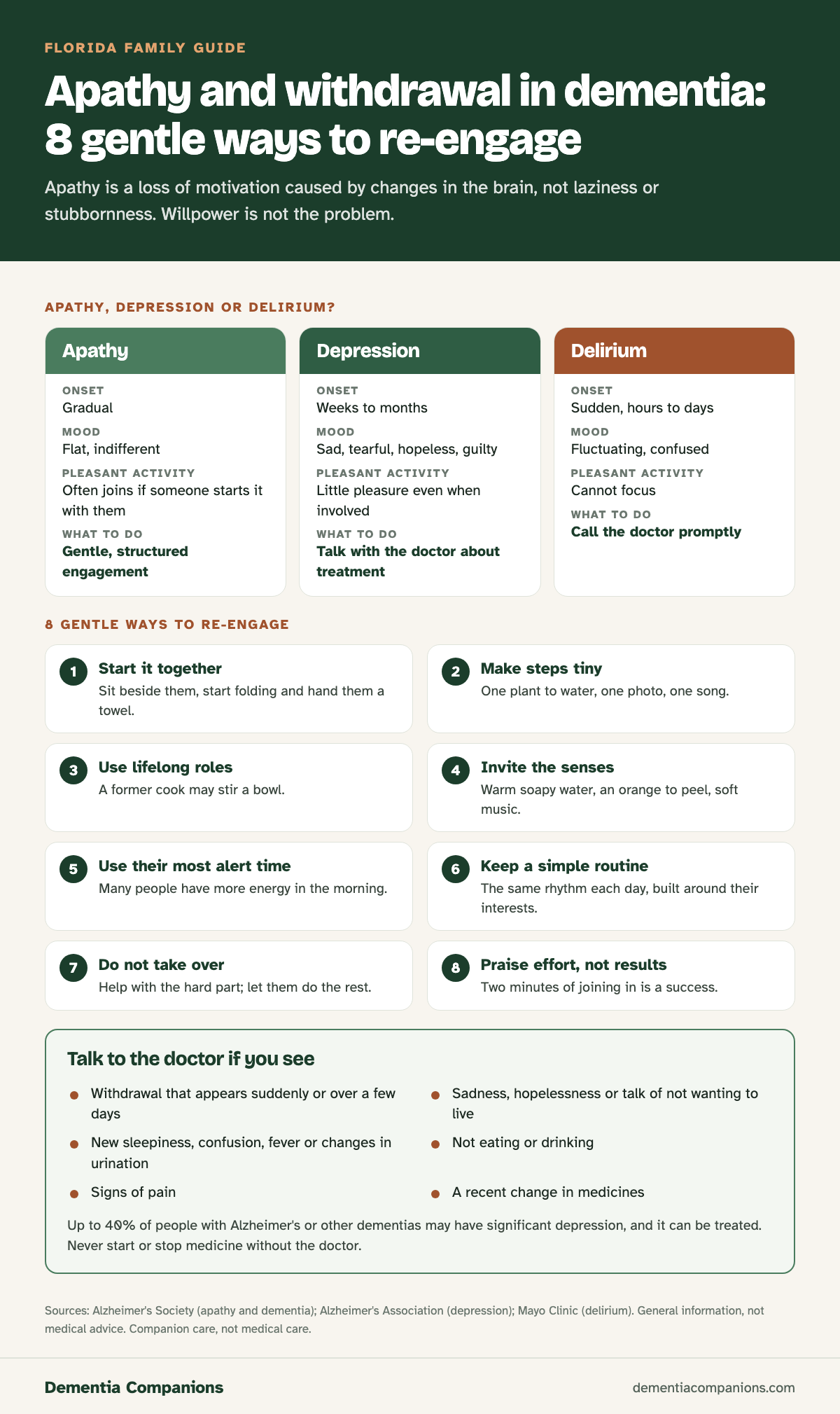
Apathy and depression share signs such as lost interest and low energy, and even doctors can find them hard to tell apart. The Alzheimer’s Society notes the key difference: depression involves more negative emotions, such as sadness or guilt, while a person with apathy may not seem troubled by their situation.
Depression is common too. The Alzheimer’s Association says experts estimate that up to 40% of people with Alzheimer’s or other dementias may have significant depression, and that it can be treated.
| What you see | Apathy | Depression | Delirium |
|---|---|---|---|
| Onset | Gradual | Weeks to months | Sudden, hours to days |
| Mood | Flat, indifferent | Sad, tearful, hopeless, guilty | Fluctuating, confused |
| Response to a pleasant activity | Often joins if someone starts it with them | Little pleasure even when involved | Cannot focus |
| Alertness | Usually normal | Usually normal, may sleep poorly | Drowsy or agitated |
| What to do | Gentle, structured engagement | Talk with the doctor about treatment | Call the doctor promptly |
Other causes worth ruling out
- Sudden withdrawal: the quiet, drowsy form of delirium can look like apathy. The Mayo Clinic lists infections such as UTIs, dehydration and medications among common triggers. See our guide to sudden confusion and delirium.
- Hearing or vision loss: the NIDCD lists avoiding groups and feeling left out among signs of hearing loss. Our article on dementia and hearing loss can help.
- Pain: a sore hip or bad tooth can make anyone want to sit still.
- Medication side effects: new drugs or dose changes can cause drowsiness or flatness.
- Too much or too little: overwhelming noise and clutter, or long empty days with nothing to do.
- Heat: an overly warm room in a Florida summer, or not drinking enough, can leave anyone sluggish.
8 gentle ways to re-engage your loved one
The goal is not to fill every hour. It is to offer small, pressure-free openings for connection, and to count every bit of participation as a win.
- Start it together. “Do you want to fold laundry?” invites a no. Sitting beside them, starting to fold and handing them a towel often works. Doing beats deciding.
- Make steps tiny. One plant to water, one photo, one song. Small and finished beats big and abandoned.
- Use lifelong roles. A former cook may stir a bowl; a retired teacher may “help” sort papers; a lifelong churchgoer may brighten at hymns.
- Invite the senses. Warm soapy water, a fragrant orange to peel, a pet to stroke, soft music.
- Follow their best hour. Many people have more energy in the morning. Plan pleasant activities then.
- Keep a simple routine. The Alzheimer’s Society recommends a daily routine and weekly plan built around their interests. Our guide to a calming daily structure shows how.
- Do not take over. Doing everything for them can erode confidence and skills. Help with the hard part, let them do the rest.
- Praise effort, not results. Two minutes of participation is a success. A smile and thanks invite them to try again.
Words that open doors
How you invite matters as much as what you invite them to do. Open questions ask the brain to plan, which is exactly what apathy makes hard. Short, warm statements make joining easier.
- Instead of “What would you like to do today?” try “Come sit with me. I need your help with these.”
- Instead of “Don’t you want to go outside?” try “Let’s take our coffee to the porch.”
- Instead of “You used to love this” try “Show me how you did this.”
- Instead of “Why won’t you try?” try “That’s okay. We’ll do it together later.”
Avoid comparisons with the past or with other people. They tend to bring embarrassment rather than motivation.
Music, movement and the outdoors
Music often reaches people when little else does, and the Alzheimer’s Society notes that structured therapies such as music therapy may help with apathy where available. Try a playlist from their teens and twenties; see using a familiar song to connect. A short walk, a few minutes of chair exercise or sitting outside in the morning before the heat builds can also lift energy.
For more ideas sorted by stage, see our dementia activities library and 10 meaningful activities at home.
What about medication?
The Alzheimer’s Society notes that apathy is hard to treat with medicine and that antidepressants show little evidence of benefit for apathy in Alzheimer’s, mixed or vascular dementia, and may even worsen it. Depression is different and is often treatable. This is why an accurate assessment matters. Never start or stop medication without the doctor.
Activity ideas matched to ability
The Alzheimer’s Society suggests choosing tasks your loved one can realistically manage, so they feel in control and regain confidence. What works changes as dementia progresses.
| Stage | Activities that often engage | How to start them |
|---|---|---|
| Early | Gardening, card games, cooking a familiar recipe, volunteering, short outings | Invite them to “help” with a real task, and give them a clear role |
| Middle | Folding towels, sorting buttons or coins, watering plants, looking at photo books, singing | Set materials out and begin yourself; hand them the next item |
| Late | Listening to music, hand massage with lotion, holding a soft object, sitting outdoors | Offer one sensation at a time and watch for small signs of pleasure |
A sample day that gently builds engagement
- Morning: open the blinds, a short walk or time on the porch before the Florida heat, breakfast together.
- Late morning: the “main” activity of the day, at their most alert time, kept to 20 or 30 minutes.
- Lunch: involve them in one small step, such as buttering bread or setting the table.
- Afternoon: rest, then music or a familiar TV program watched together and talked about.
- Evening: a calm routine, low light and a phone call from a family member.
Use the same rhythm each day so your loved one does not have to decide what comes next. Our daily routine planner can help you sketch one.
Making visits from friends work
Withdrawal often shrinks a person’s social world. Friends may stop calling because they do not know what to say. Invite one friend at a time for a short visit with a simple shared activity, such as looking at old photos or listening to a ballgame. Brief, regular contact tends to work better than long, rare visits.
When to talk to the doctor
- Withdrawal that appears suddenly or over a few days
- Sadness, tearfulness, hopelessness or talk of not wanting to live
- New sleepiness, confusion, fever or changes in urination
- Not eating or drinking
- Signs of pain, or a recent change in medications
A medical review can rule out treatable causes and look for depression. This article is general information, not medical advice. If your loved one talks about harming themselves, seek help immediately by calling 911.
Example: a morning routine in Clearwater
This is an illustrative scenario, not a real client story. A wife in Clearwater notices that her husband, a retired boat mechanic with Alzheimer’s, now spends most days in his recliner. His doctor checks for infection, reviews his medicines and finds no sign of depression, and explains that apathy is part of his dementia.
The family arranges a companion for three mornings a week. She does not ask if he wants to do anything. She simply sets out his old tackle box on the patio table and starts sorting lures, asking his advice. Within ten minutes he is explaining which lure works for snook. Some days he joins for five minutes; some days for an hour. Her visit notes show his wife which activities draw him in, and she starts using the same approach on weekends.
Be gentle with yourself, too
Watching someone you love retreat into stillness can be lonely and quietly heartbreaking. You may miss the person who laughed at your jokes or asked about your day. Frustration, sadness and even resentment are normal and do not make you a bad caregiver. The Alzheimer’s Association reports that 59% of dementia caregivers rate their emotional stress as high or very high.
Measure success in moments of connection, not productivity. Let someone else take a turn at drawing your loved one out while you rest. Our guide to looking after yourself has practical ideas.
Frequently asked questions
Is apathy a sign that dementia is getting worse?
Apathy often becomes more noticeable as dementia progresses, but it can appear at any stage, and earlier in some types such as frontotemporal and Lewy body dementia. A sudden change, though, may signal illness and should be checked by a doctor.
How can I tell apathy from depression?
Depression usually involves sadness, tearfulness, guilt or hopelessness. Apathy is more of a flat indifference without distress. They can overlap, so ask the doctor for an assessment.
Should I keep pushing my loved one to do things?
Gentle invitation works better than pressure. Start activities alongside them, offer one small step, and accept “not today” without argument. Try again later.
Can medication help apathy in dementia?
Medicines have limited evidence for apathy itself, and antidepressants may not help or may make it worse, according to the Alzheimer’s Society. Depression, if present, is often treatable. Discuss options with the doctor.
Can a companion help with apathy?
Yes. A consistent companion can start activities alongside your loved one, use their lifelong interests, keep a steady routine and report what engages them, giving you time to rest.
Still have questions?
Talk it through with us. A free call about your family's situation, with no obligation.
Call (689) 333-6079Send us a message- Screened for dementia care experience
- Florida ADRD training before the first visit
Conclusion
Apathy and withdrawal in dementia can feel like a wall between you and the person you love, but connection is still possible, often in quieter, simpler forms.
Rule out depression, illness and hearing loss, then focus on small shared activities, routine and lifelong interests. Patience, repetition and a warm presence often reach your loved one more than any single activity.
If you would like a caring companion to gently draw your loved one out, get 3 free caregiver profiles within 48 hours or call (689) 333-6079. Explore our memory and engagement visits.
Small moments of connection
A consistent companion who learns what still lights your loved one up, $35 an hour for 40+ hours a week.
Want a companion screened for dementia care experience?
We'll send 3-5 caregiver video profiles within 48 hours, so you can watch their video interviews before you decide. $35/hour for 40+ hours a week, no contracts.