
For dementia caregivers, looking after yourself is part of the job, not a luxury. Protect a little time each day, ask for help in specific terms, keep your own medical appointments, stay connected to people who understand, and use respite before you hit empty. These steps help you stay well enough to keep caring for the person you love.
This guide is for you, not the person you care for. It covers the early warning signs of strain, seven realistic self-care habits, Florida programs that offer breaks, and what to do if you are struggling now.
Table of contents
Why dementia caregivers need care too
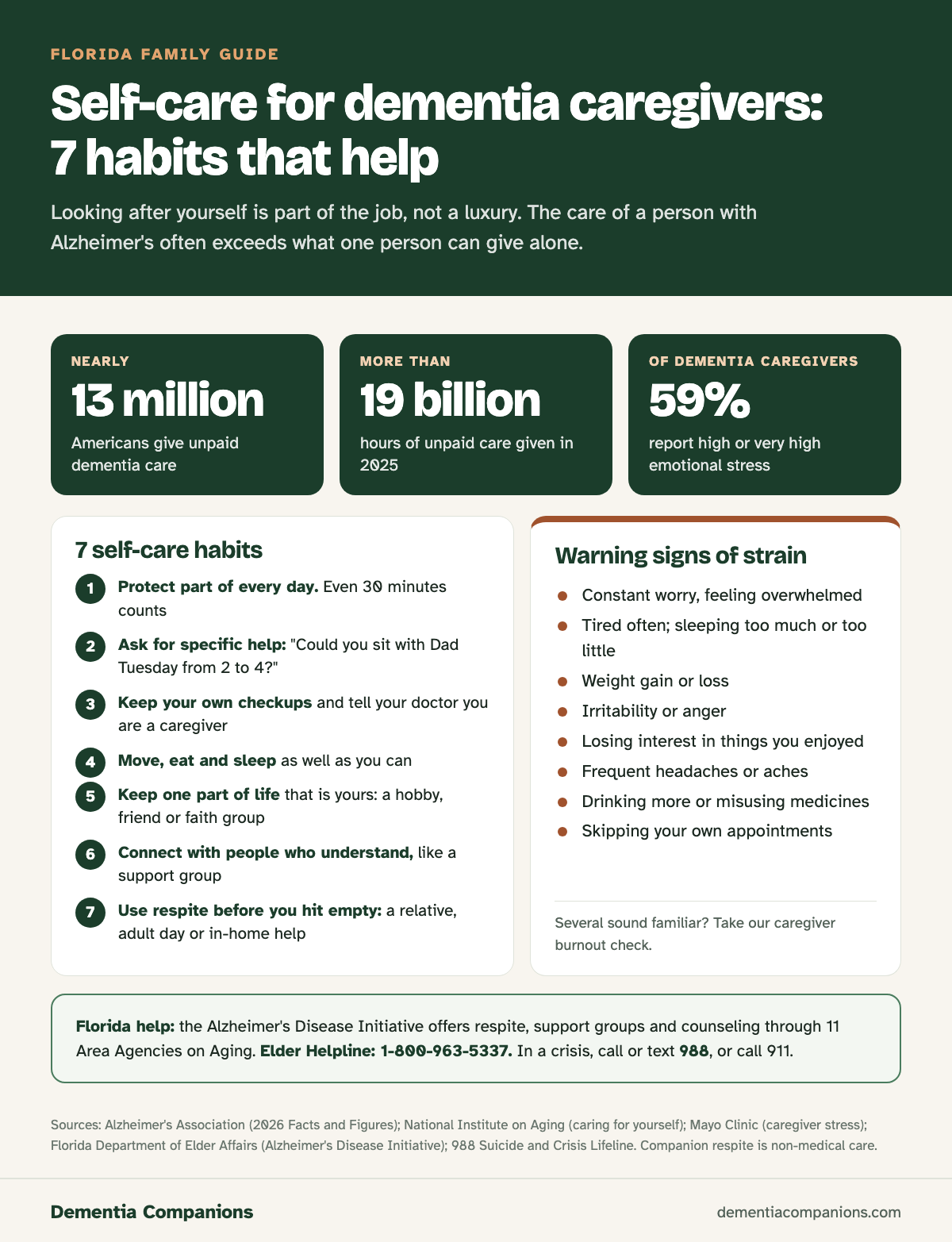
Dementia care is long, unpredictable, and emotionally heavy. According to the Alzheimer’s Association’s 2026 Facts and Figures, nearly 13 million Americans provide unpaid care for someone with dementia, giving more than 19 billion hours of care in 2025. Fifty-nine percent of dementia caregivers report high or very high emotional stress.
The National Institute on Aging puts it plainly: the care of a person with Alzheimer’s often exceeds what one person can provide alone. Needing help is normal.

Warning signs you should not ignore
Strain usually creeps in slowly, disguised as “just a hard week.” Mayo Clinic lists signs of caregiver stress, including:
- Constant worry or feeling overwhelmed
- Feeling tired often, or sleeping too much or too little
- Weight gain or loss
- Irritability or anger
- Losing interest in things you used to enjoy
- Frequent headaches or other aches
- Drinking more or misusing medicines
- Skipping your own medical appointments
If several sound familiar, take our caregiver burnout check, and read our guide to recognizing and recovering from burnout.
7 self-care habits for dementia caregivers
None of these require a spa day. They require a little planning and permission.
1. Protect a small piece of every day
The NIA recommends taking breaks each day. Even 30 minutes to walk, read, garden, or sit quietly counts. Put it on the calendar and treat it like an appointment.
2. Ask for help in specific terms
“Let me know if you need anything” rarely turns into help. Try “Could you sit with Dad Tuesday from 2 to 4?” or “Could you pick up his prescription Friday?” The NIA suggests asking people to help in specific ways, like making a meal or taking your loved one out for a short time.
3. Keep your own health appointments
Caregivers often skip checkups and screenings. Book them, tell your doctor you are a caregiver, and ask for help with sleep, stress, or low mood. Mayo Clinic suggests the same.
4. Move, eat, and sleep as well as you can
Regular activity, decent meals, and enough water make a difference to mood and energy. If nights are broken, nap when you can and look at the causes; our guide to dementia sleep changes may help.
5. Keep one part of life that is yours
A hobby, a friendship, a faith community, or a class reminds you who you are beyond caregiving. The NIA lists keeping up hobbies and interests among its core self-care tips.
6. Connect with people who understand
Support groups, in person or online, let you talk without explaining. Ask your local Area Agency on Aging or the Alzheimer’s Association (Helpline: 800-272-3900) about groups near you. A counselor or social worker can also help; the NIA notes Medicare, Medicaid, and some private plans may cover part of the cost of mental health care.
7. Use respite before you hit empty
Respite means someone else takes over for a while so you can rest. It can be a relative, an adult day program, or in-home help. Our guide to taking a break without guilt explains the options.
Self-care ideas by time available
| Time you have | Ideas |
|---|---|
| 5 minutes | Slow breathing, stretch, step outside, text a friend |
| 30 minutes | A walk, a short nap, a chapter of a book |
| Half a day | Your own doctor visit, lunch with a friend, a class |
| A full day | A beach day, a church event, catching up on sleep |
Longer breaks usually need someone else to cover care, so plan them a week or two ahead.
Florida help for caregivers
Florida has programs designed to give caregivers a break.
- Alzheimer’s Disease Initiative. Through the Florida Department of Elder Affairs’ Alzheimer’s Disease Initiative, eligible families can access in-home, facility, and emergency respite, plus counseling, support groups, and training, delivered through the 11 Area Agencies on Aging.
- Elder Helpline. Call 1-800-963-5337 to reach local aging services in your county.
- Family and Medical Leave Act. Mayo Clinic notes eligible employees may take up to 12 weeks of unpaid leave a year to care for relatives.
Our page on Florida programs that help pay for care has more detail.
If you care for a spouse
Spouses often carry the heaviest load with the least backup. You may be dealing with your own health issues, losing a partner’s companionship while still living together, and feeling you should be able to do it all. You do not have to. Adult children, friends, faith communities, and paid help can all share the work. Our page on dementia care for spouse caregivers covers this in more depth.
Make a backup plan
Many dementia caregivers worry about what happens if they get sick. The NIA suggests deciding with family who would step in, and keeping a notebook with emergency numbers, medicines, daily routines, favorite activities, and what calms your loved one. Keep it where any helper can find it, and update it every few months. Knowing a plan exists can ease a surprising amount of worry.
Kind things to tell yourself
The NIA suggests a few phrases for hard days. In our own words: I am doing my best. This would be hard for anyone. I do not have to be perfect. The illness causes the behaviors, not me. I can enjoy the peaceful moments. I can ask for help.
Feelings like sadness, frustration, guilt, and even anger are normal parts of caregiving. They do not mean you love your person any less.
Example: a sustainable week
This is an illustrative example, not a real client. A wife in Fort Lauderdale cares for her husband with moderate dementia and has started snapping at him and skipping meals.
- She books a companion for Monday and Thursday afternoons and uses one for her own doctor visit.
- Her son takes Saturday mornings so she can attend a support group.
- She walks 20 minutes each morning while her husband has breakfast with the companion.
- She tells her doctor she is a caregiver and gets help with her sleep.
Within a month she feels steadier, and so does home life. Nothing about her husband’s illness has changed, but she has more patience on hard evenings, and the companion’s visit notes reassure her that his afternoons are calm and engaged.
When to get help right away
If you feel hopeless, have thoughts of harming yourself, or worry you might hurt the person you care for, reach out now. Call or text 988, the 988 Suicide and Crisis Lifeline, which is available round-the-clock, call 911 in an emergency, or talk to your doctor today. You deserve support, and getting it protects you both.
Frequently asked questions
How can dementia caregivers avoid burnout?
Take small breaks every day, ask for specific help, keep your own health appointments, stay connected to supportive people, and arrange regular respite before you are exhausted.
Is it selfish to take time for myself?
No. Rest keeps you healthy enough to keep caring. A rested caregiver is more patient and makes better decisions.
What if I feel guilty leaving my loved one with someone else?
Guilt is common. Start with short breaks, choose a consistent helper your loved one can get to know, and remind yourself that your well-being is part of their care.
Where can Florida caregivers find support groups?
Call the Elder Helpline at 1-800-963-5337 or the Alzheimer’s Association Helpline at 800-272-3900 to find groups near you, in person or online.
How much does in-home respite cost?
Dementia Companions charges $35 an hour for 40+ hours a week, with no long-term contract; call us about shorter schedules. Some long-term care insurance policies reimburse companion care.
Still have questions?
Talk it through with us. A free call about your family's situation, with no obligation.
Call (689) 333-6079Send us a message- Screened for dementia care experience
- Florida ADRD training before the first visit
Conclusion
Dementia caregivers carry a heavy load, and self-care is how you keep carrying it. Small daily breaks, specific requests for help, your own health care, real connection, and regular respite all count.
Watch for warning signs, use Florida’s programs, and reach out early. You matter too.
If you need regular time off, get 3 free caregiver profiles within 48 hours or call (689) 333-6079. Learn about our dementia respite care at $35 an hour for 40+ hours a week.
Want a companion screened for dementia care experience?
We'll send 3-5 caregiver video profiles within 48 hours, so you can watch their video interviews before you decide. $35/hour for 40+ hours a week, no contracts.