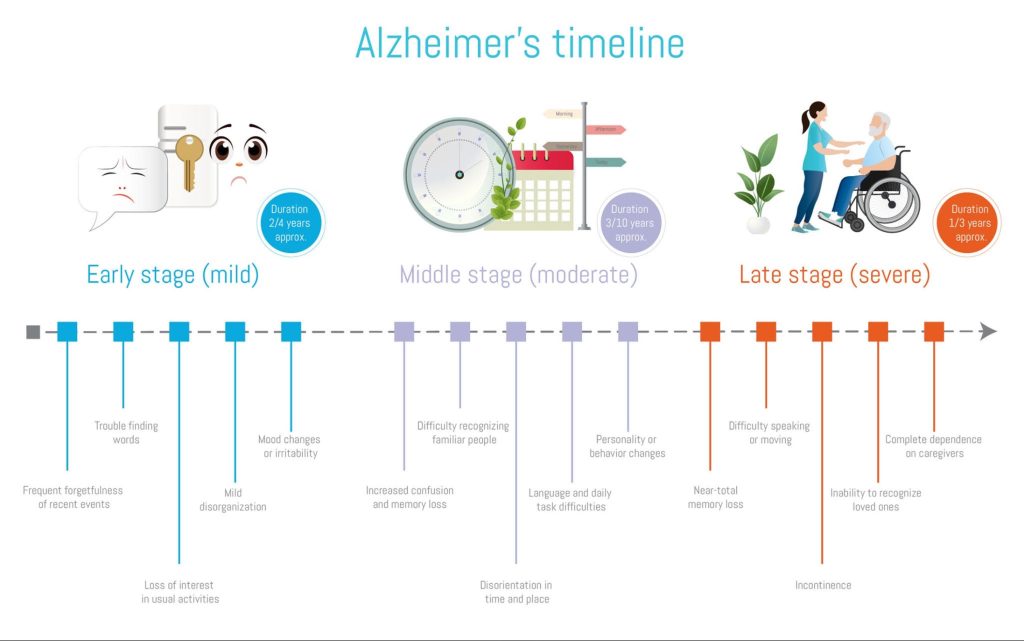
The stages of dementia are usually described as early (mild), middle (moderate), and late (severe). In the early stage, a person often still lives independently with some memory slips. The middle stage is usually the longest and brings more confusion and need for help. In the late stage, round-the-clock care is needed. Progress varies widely from person to person.
This guide explains each stage in plain terms, what your loved one may experience, how your role as a caregiver changes, and which Florida resources help at each point. It is general information; your loved one’s doctor is the right person to discuss their specific diagnosis.
Table of contents
How the stages of dementia work
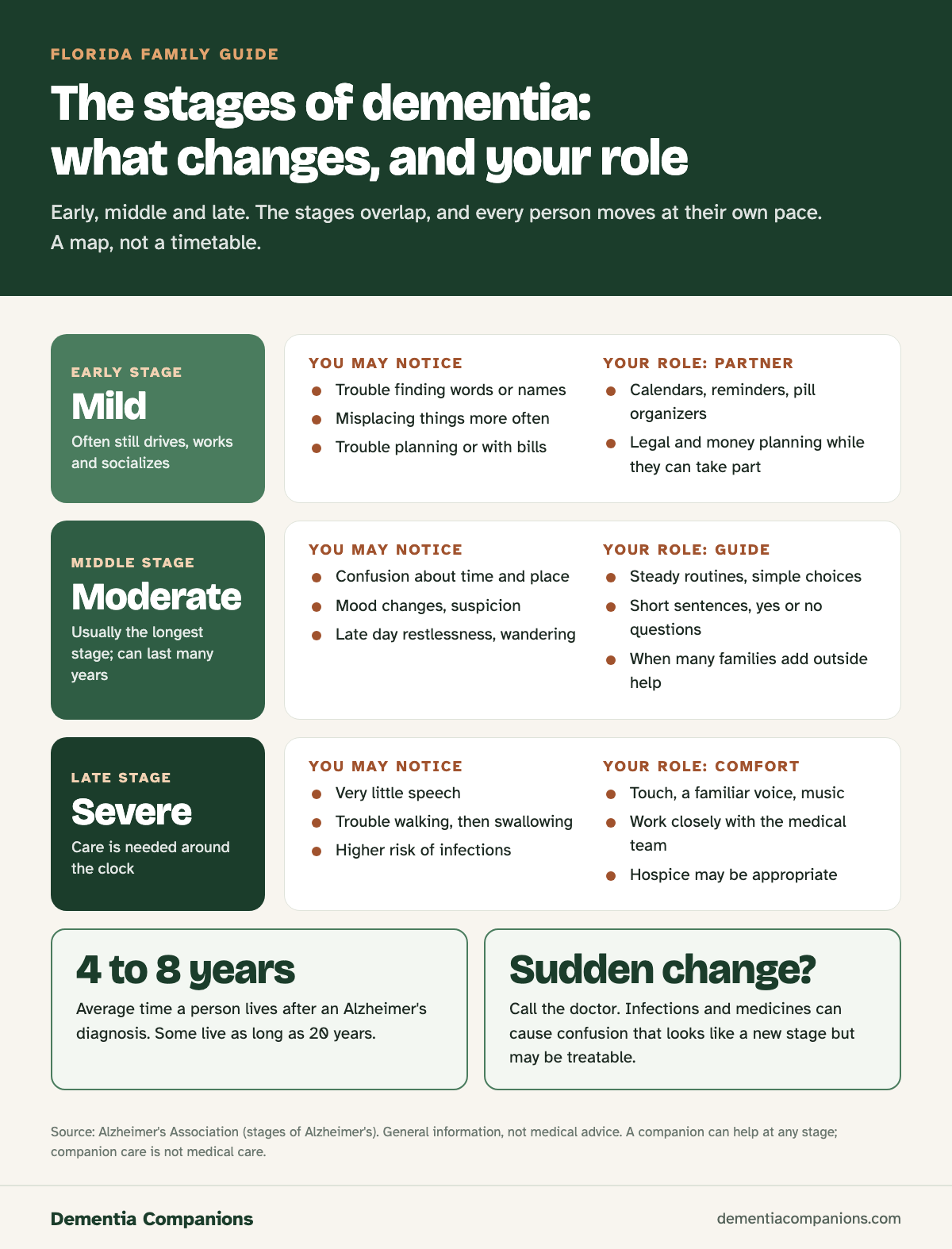
The Alzheimer’s Association describes Alzheimer’s as progressing slowly through three general stages, with overlap between them. On average, a person lives four to eight years after diagnosis, though some live as long as 20 years. Brain changes can begin years before symptoms appear.
Stages are a map, not a timetable. Your loved one may have a clear, bright day followed by a confused one, and may show signs of two stages at once. Some doctors use more detailed scales with more steps; the three-stage model is the one most families find useful.
Different types of dementia
Alzheimer’s disease is the most common cause of dementia, but not the only one. Vascular dementia, Lewy body dementia, and frontotemporal dementia can follow different patterns, with movement, mood, or behavior changes appearing earlier. Ask the doctor what to expect for your loved one’s diagnosis.

The early stage (mild dementia)
In the early stage, your loved one can often still drive, work, and socialize. Family members may notice changes before others do.
What you may notice
- Trouble finding the right word or remembering names
- Misplacing objects more often
- Difficulty planning, organizing, or handling bills
- Forgetting something just read
Many people are aware of these slips, which can bring frustration, anxiety, or denial.
Your role
Act as a partner. Support independence with calendars, reminders, and pill organizers. The Alzheimer’s Association notes this is a good time for legal, financial, and end-of-life planning, while your loved one can take part. Our guide to legal and financial planning in Florida explains the key documents.
The middle stage (moderate dementia)
The middle stage is typically the longest and can last many years. Care needs grow steadily.
What you may notice
- Confusion about time and place, and forgetting personal history
- Mood changes, suspicion, or repetitive behaviors
- Trouble choosing clothing or managing bathing
- Bladder or bowel control problems
- Sleep changes and late-day restlessness
- Wandering and getting lost
Your loved one can still do many daily activities with help and reminders.
Your role
Move from partner to guide. Keep routines predictable, simplify choices, and communicate with short sentences and yes-or-no questions. Focus on feelings rather than correcting facts. Safety becomes central: see our guides to sundowning and dementia wandering. This is also when many families add regular outside help.
The late stage (severe dementia)
In the late stage, symptoms are severe and around-the-clock care is needed.
What you may notice
- Very limited speech; communication through sounds and expressions
- Loss of awareness of recent events and surroundings
- Trouble walking, sitting, and eventually swallowing
- Higher risk of infections, especially pneumonia
Even now, your loved one may respond to touch, a familiar voice, and music.
Your role
Focus on comfort, dignity, and connection. Work closely with the medical team. The Alzheimer’s Association notes that hospice care may be appropriate in this stage. Our guide to late-stage dementia care covers comfort care in depth.
Stages of dementia at a glance
| Stage | Typical signs | Caregiver focus |
|---|---|---|
| Early | Word-finding, misplacing items, planning trouble | Independence, planning, support |
| Middle | Confusion, mood changes, wandering, sleep changes | Routine, safety, more hands-on help |
| Late | Little speech, mobility and swallowing problems | Comfort, dignity, hospice support |
Not sure where your loved one fits? Our dementia stage checker can help you prepare questions for the doctor.
Example: one family across the stages
This is an illustrative example, not a real client. A husband in Jacksonville cares for his wife after her Alzheimer’s diagnosis.
- Early: They set up a shared calendar, name him health care surrogate, and keep up her book club.
- Middle: She stops driving, starts asking to “go home” in the evening, and a companion begins visiting three afternoons a week.
- Late: Her doctor recommends hospice. The companion still visits to play her favorite hymns while the hospice team handles medical care.
Each stage brings a new plan, but the goal stays the same: comfort and connection.
How communication changes across the stages
The Alzheimer’s Association describes a shift in how to talk with your loved one as dementia progresses. In the early stage, include them fully, speak directly to them, and give them time. In the middle stage, talk one-on-one in a quiet place, ask one question at a time, and show rather than tell. In the late stage, approach from the front, say who you are, and rely on touch, tone, and expression. Your presence matters even when words are few.
Questions to ask the doctor at each stage
Bring a written list to appointments, along with a log of recent changes.
- What type of dementia does my loved one have, and how might it progress?
- Which symptoms should prompt a call between visits?
- Do any current medicines affect memory, sleep, balance, or mood?
- Is it still safe for them to drive, cook, or manage money?
- Would an occupational therapy or home safety assessment help?
- When should we start talking about hospice or palliative care?
Write down the answers and share them with siblings and helpers so everyone works from the same plan.
Caring for yourself through every stage
Caregiving demands grow with each stage, and so does the risk of exhaustion. Build breaks into your week from the start rather than waiting for a crisis. Ask relatives for specific help, join a support group, keep your own medical appointments, and use respite care before you feel desperate. A rested caregiver makes better decisions at every stage of the journey.
Florida resources at every stage
Help is available long before a crisis.
- Memory Disorder Clinics. Florida’s Alzheimer’s Disease Initiative authorizes 17 memory disorder clinics that offer diagnosis, referral, and caregiver education.
- Respite and support. The same program funds respite, support groups, and caregiver training through Florida’s 11 Area Agencies on Aging.
- Elder Helpline. Call 1-800-963-5337 to reach local aging services.
- Alzheimer’s Association. The Helpline is 800-272-3900.
See our full list of Florida dementia resources.
When to call the doctor
Gradual change is expected. Sudden change is not. Call your loved one’s doctor if confusion worsens over hours or days, if they stop eating or drinking, after a fall, or if new symptoms such as fever, pain, or trouble breathing appear. Infections and medicines can cause sudden confusion that looks like a jump to a later stage but may be treatable. This article is general information, not medical advice.
Frequently asked questions
How long does each stage of dementia last?
It varies widely. The Alzheimer’s Association reports that people live four to eight years on average after an Alzheimer’s diagnosis, and some live 20 years. The middle stage is usually the longest.
Can someone skip a stage?
Stages overlap, and progress is uneven. A person can seem to move quickly after an illness or hospital stay. Sudden changes should always be checked by a doctor.
Is mild cognitive impairment the same as early-stage dementia?
No. Mild cognitive impairment involves noticeable memory or thinking changes that do not significantly interfere with daily life. Some people with it go on to develop dementia; others do not.
When should we consider hospice?
Hospice may be appropriate in the late stage, when the focus shifts to comfort. Ask your loved one’s doctor about eligibility.
At what stage do families usually add in-home help?
Many add help in the middle stage, when safety concerns and caregiver strain rise. Starting earlier lets your loved one build trust with a companion while they can still enjoy outings and conversation.
Still have questions?
Talk it through with us. A free call about your family's situation, with no obligation.
Call (689) 333-6079Send us a message- Screened for dementia care experience
- Florida ADRD training before the first visit
Conclusion
The stages of dementia give families a rough map: early independence with support, a long middle stage of growing need, and a late stage focused on comfort. Every person moves at their own pace.
Plan early, adjust your role as needs change, and use Florida’s memory clinics, helplines, and respite programs.
When you are ready for help at any stage, get 3 free caregiver profiles within 48 hours or call (689) 333-6079. Learn about dementia companion care at $35 an hour for 40+ hours a week.
Want a companion screened for dementia care experience?
We'll send 3-5 caregiver video profiles within 48 hours, so you can watch their video interviews before you decide. $35/hour for 40+ hours a week, no contracts.