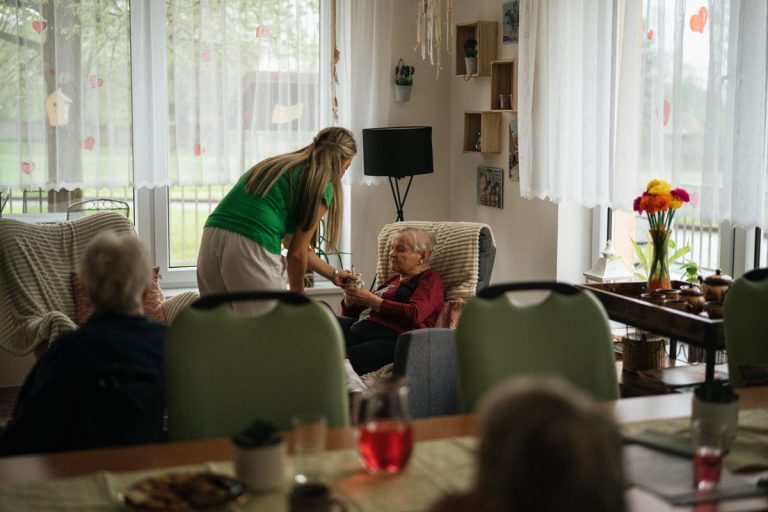
Memory care vs in-home care in Florida is a choice between two regulated systems. Memory care is a secured part of a state-licensed assisted living facility with staff on site around the clock, while in-home care brings an AHCA-registered or licensed caregiver to your loved one’s home for set hours. Home usually costs less part-time; memory care wins when 24-hour supervision is needed.
This guide looks at the choice through a Florida lens: what state law requires of each, how the costs compare using 2025 Florida data, how to check a provider, and Florida factors such as heat and hurricane season. For a broader, stage-by-stage decision guide, see our post on in-home dementia care vs. memory care facilities.
Table of contents
How Florida regulates memory care
In Florida, “memory care” is a description, not a separate license. Most memory care units operate inside assisted living facilities (ALFs) licensed by the Agency for Health Care Administration (AHCA). According to AHCA, ALFs hold a standard license and may add specialty licenses for extended congregate care, limited nursing services or limited mental health.
An ALF that advertises special care for people with Alzheimer’s or related disorders must meet extra standards under section 429.178 of Florida law:
- An awake staff member on duty at all hours in facilities with 17 or more residents (smaller facilities may instead use other ways to monitor safety)
- Activities designed specifically for people with cognitive impairment
- A physical environment that provides for residents’ safety and welfare
- Staff dementia training and continuing education under Florida’s dementia training law
How Florida regulates in-home care
In-home care comes in different forms. Companion and homemaker providers, which offer non-medical help such as company, meals and errands, must register with AHCA under section 400.509 and include their registration number in advertising. Home health agencies, which provide nursing and personal care, are licensed separately. Nurse registries refer independent contractors.
Florida’s dementia training law, section 430.5025, covers both settings. Employees of ALFs, home health agencies, nurse registries and companion or homemaker providers receive basic dementia information when hired, and those with regular client contact complete a one-hour state training within 30 days. Personal care staff then complete more training within seven months: two more hours for in-home providers, three for ALFs. Staff in facilities that advertise specialized dementia care complete four hours of dementia-specific training within six months, plus at least four hours of continuing education each year. Staff of these providers must also pass Level 2 background screening.
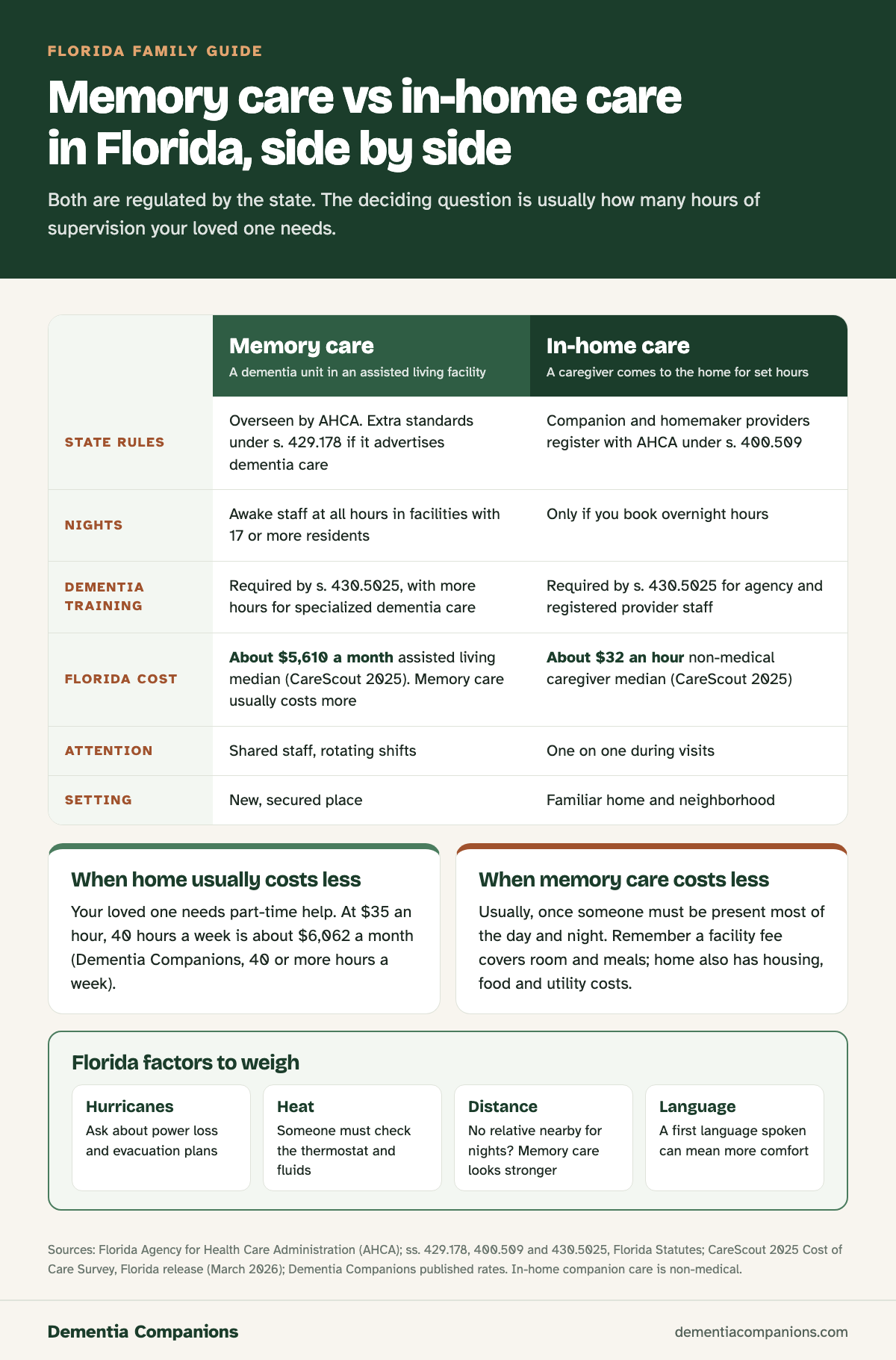
Memory care vs in-home care in Florida: side by side
| Factor | Memory care (ALF dementia unit) | In-home care |
|---|---|---|
| State oversight | AHCA-licensed ALF; s. 429.178 if it advertises dementia care | AHCA registration (companion/homemaker) or license (home health) |
| Night staffing | Awake staff at all hours in facilities of 17+ residents | Only if you book overnight hours |
| Dementia training | Required; more hours for specialized dementia care | Required for agency and registered provider staff |
| Florida cost benchmark | Assisted living median about $5,610/month in 2025; memory care usually more | Non-medical caregiver median about $32/hour in 2025 |
| Attention | Shared staff, rotating shifts | One-on-one during visits |
| Setting | New, secured environment | Familiar home and neighborhood |
Comparing costs with Florida numbers
CareScout’s 2025 survey, released in March 2026, put Florida’s median for assisted living at $67,320 a year, or about $5,610 a month, and the median for a non-medical in-home caregiver at about $32 an hour, according to CareScout’s Florida release. There is no Florida median for memory care, but it usually costs more than standard assisted living because of secured spaces, more staff time and dementia programming.
The break-even point depends on hours. At $35 an hour, 40 hours a week of in-home care costs about $6,062 a month; our rate is $35/hour for 40+ hours a week, so call us about shorter schedules. Once your loved one needs someone present most of the day and night, home care usually costs more than a memory care unit. Remember that home also carries housing, food and utility costs, while a facility fee covers room and meals. Our Florida dementia care cost comparison lays out every setting.
How to check a Florida provider
For a memory care community
- Look up the facility and its license type on AHCA’s Florida Health Finder, and ask to see recent inspection results.
- Ask whether it advertises dementia care under s. 429.178 and how it meets the night staffing rule.
- Ask how many staff have completed the specialized dementia training hours and how often they get continuing education.
- Ask about the full monthly price, level-of-care fees, and discharge policies if needs increase.
For an in-home provider
- Ask for the AHCA registration or license number, which should appear in advertising.
- Confirm caregivers have Level 2 background screening and the state dementia training.
- Ask whether your loved one will have one consistent caregiver and what happens when that person is sick.
- Ask for every charge in writing, including minimums, nights and holidays.
Our guide on how to choose a dementia caregiver in Florida includes a full interview checklist.
Florida factors to weigh
Hurricane season. Ask any facility how it handles power loss and evacuation, and ask any in-home provider whether caregivers can help with storm preparation. If your loved one stays home, you will need your own plan; see our hurricane preparedness guide.
Heat. Older adults with dementia may not notice heat or thirst. At home, someone needs to check the thermostat and fluids on hot days.
Distance and family. Many Florida retirees live far from their children. If no relative is nearby to cover nights and emergencies, the case for memory care grows stronger.
Language and culture. In South Florida especially, a caregiver or community that speaks your loved one’s first language can make a big difference in comfort.
Example: one decision, two years apart
This is an illustrative example, not a real client. A retired nurse in Boca Raton is diagnosed with Alzheimer’s at 78. She lives with her husband, who is healthy, and their daughter lives in Jupiter.
Year one: she sleeps well and enjoys her garden. The family chooses in-home care: a companion three mornings a week for walks, cooking and her book club, about $1,820 a month at 12 hours a week. Her husband keeps his golf game and doctor visits.
Year three: she begins waking at 2am and trying to leave, and her husband has a fall. The family tours three memory care communities, checks their AHCA records and asks about night staffing, then moves her to one near her daughter. They keep a companion for two afternoons a week during the first month to ease the transition.
When to involve the doctor
Before deciding, ask your loved one’s doctor to review their stage, medications and safety. A sudden worsening of confusion or behavior can come from an infection, dehydration or a medication side effect, which are treatable, and should be checked before you decide the move is necessary. The doctor can also complete any medical forms a facility requires.
Watch a caregiver before you choose
Families watch video interviews like these and choose their companion. No one is sent to your parent's home until you have watched them and said yes.



Frequently asked questions
Is memory care a separate license in Florida?
No. Memory care units usually operate within licensed assisted living facilities. If an ALF advertises special care for people with Alzheimer’s or related disorders, it must meet the extra standards in s. 429.178, including night staffing, dementia activities, a safe environment and staff training.
Do in-home caregivers in Florida need dementia training?
Staff of home health agencies, nurse registries and companion or homemaker providers are covered by Florida’s dementia training law. Those with regular client contact complete a one-hour state course within 30 days, and personal care staff complete two more hours within seven months. Families who hire directly must check training themselves.
Which is cheaper in Florida, memory care or in-home care?
For part-time help, in-home care is usually cheaper. For 24-hour supervision, memory care is usually cheaper. Compare your loved one’s real hours of need against each community’s all-in quote.
Can we start at home and move to memory care later?
Yes, and many Florida families do exactly that. In-home care often covers the early and middle stages, and a move happens when nights or safety become unmanageable. Touring communities and checking their AHCA records while things are calm means you will not be choosing under pressure after a fall or hospital stay.
Can Florida Medicaid pay for either option?
Florida’s Medicaid Long-Term Care program can cover adult companion care at home and assisted living services for people who qualify for nursing-home level of care and meet financial rules. Waitlists are common. See our Florida Medicaid guide.
Still have questions?
Talk it through with us. A free call about your family's situation, with no obligation.
Call (689) 333-6079Send us a message- Screened for dementia care experience
- Florida ADRD training before the first visit
Conclusion
Memory care vs in-home care in Florida comes down to how many hours of supervision your loved one needs, and both options are regulated by AHCA with state dementia training rules.
Use Florida cost benchmarks, check licenses and registration, and plan for heat and hurricanes whichever way you go.
If home is right for now, get 3 free caregiver profiles within 48 hours or call (689) 333-6079. Every companion in our dementia companion care service is screened for dementia care experience, and you can watch their video interviews before you decide. Our rate is $35 an hour for 40+ hours a week.
Want a companion screened for dementia care experience?
We'll send 3-5 caregiver video profiles within 48 hours, so you can watch their video interviews before you decide. $35/hour for 40+ hours a week, no contracts.