
Table of contents
- What guardianship means in Florida
- Florida asks for less restrictive options first
- Power of attorney vs health care surrogate vs guardianship in Florida
- How to get guardianship of a parent with dementia in Florida: the court process
- Emergency temporary guardianship
- What guardianship costs in Florida
- Who can be the guardian
- A note on “guardian advocate”
- When to see a Florida elder law attorney
- Day-to-day support while the paperwork gets sorted
- Frequently asked questions
- Sources
- Planning, money and family
In Florida, guardianship of a parent with dementia is a court case under Chapter 744 of the Florida Statutes. A judge decides, after an exam by a three-person committee and a hearing, whether your parent can no longer handle some or all of their own decisions, and then appoints a guardian for only the rights they can’t manage. Florida law requires the court to look for a less restrictive option first, so if your parent signed a durable power of attorney and a health care surrogate designation while they still had capacity, you may not need guardianship at all.
This guide is general information, not legal advice. A Florida elder law attorney can tell you what applies to your family.
What guardianship means in Florida
A guardian is someone the court appoints to act for another person. That person is called the ward. First, a judge must find your parent is an incapacitated person: someone who lacks the capacity to manage at least some of their property or to meet at least some of their essential health and safety needs.
Guardianship can cover two areas:
- Guardian of the person: decisions about health care, where your parent lives, and daily life.
- Guardian of the property: money, bank accounts, bills, benefits, and real estate.
Plenary vs limited guardianship
A plenary guardian exercises all the rights that can legally be handed to someone else. A limited guardian has only the powers listed in the court order, because the person can still do some things. Dementia is progressive, so a parent in the earlier stages of dementia may only need help with finances, while someone in the later stages may need more.
Even with a guardian, your parent keeps rights such as being treated with dignity, having reasonable preferences about where they live honored, receiving visitors, privacy, and asking to have rights restored.
Florida asks for less restrictive options first
Florida law says less restrictive help should be explored before a plenary guardian is appointed. A judge must consider whether an alternative will sufficiently address the problem, and may not appoint a guardian if one will. So the documents your parent signed, or can still sign, come first. Our guide to legal and financial planning after a dementia diagnosis covers them in more detail.
Durable power of attorney (Chapter 709)
A power of attorney lets your parent name an “agent” to handle financial and legal matters. It is durable if it says it keeps working after your parent becomes incapacitated. It must be signed by your parent and two witnesses and acknowledged before a notary.
A few Florida rules surprise families:
- One signed on or after October 1, 2011 takes effect when signed. Florida doesn’t allow new “springing” powers that start only upon incapacity.
- Vague wording like “my agent can do anything I can do” grants nothing. Powers must be spelled out.
- Powers such as making gifts or changing beneficiaries require your parent’s signature or initials next to each one.
- An agent can make health care decisions only if the document specifically grants that authority.
Whether a parent with dementia can still sign depends on their capacity at that moment. Ask an elder law attorney soon.
Health care surrogate (Chapter 765)
A health care surrogate is someone your parent names in writing to make health care decisions. It must be signed before two adult witnesses; the surrogate can’t be one, and at least one must be neither a spouse nor a blood relative. Authority usually starts when the doctor finds your parent can’t decide for themselves, unless your parent chose to make it effective right away. If a guardian is later appointed, the surrogate generally keeps that role unless the court changes it.
If there’s no paperwork: the health care proxy
With no surrogate, Florida lets a proxy make health care decisions without court. The order runs from any existing guardian, to a spouse, to an adult child (or a majority of available adult children), then other relatives or a close friend. A proxy covers medical decisions only, not money.
Other options to discuss
Other options worth asking an elder law attorney about include bank services like direct deposit and automatic bill pay, a trust, and supported decision-making, where trusted people help your parent make their own choices. Florida’s guardianship petition must say whether your parent already uses supported decision-making.
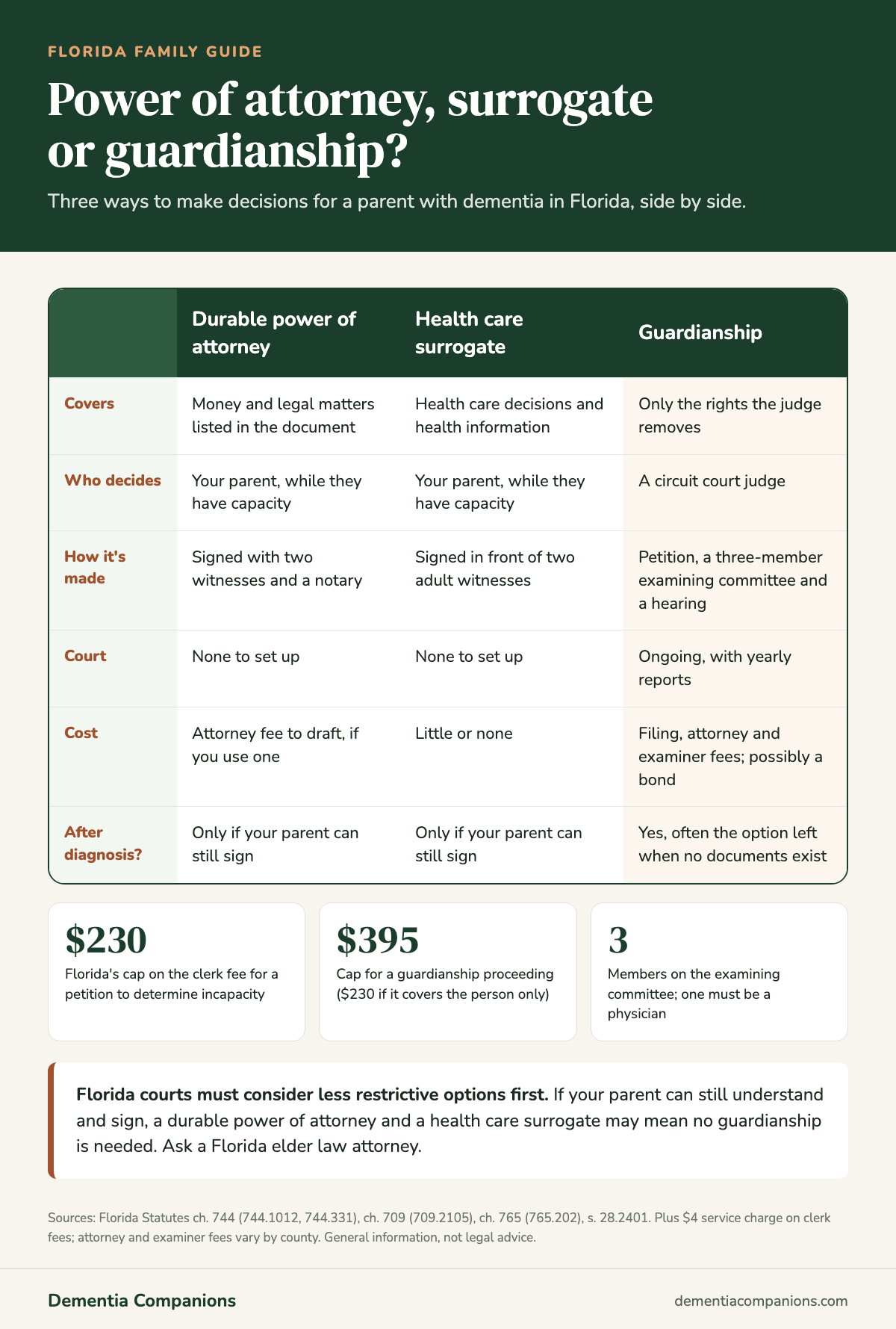
Power of attorney vs health care surrogate vs guardianship in Florida
| Durable power of attorney | Health care surrogate | Guardianship | |
|---|---|---|---|
| What it covers | Finances and legal matters listed in the document; health care only if specifically granted | Health care decisions and health information | Only the rights the judge removes, which can include health, living arrangements, and property |
| Who decides | Your parent, while they have capacity | Your parent, while they have capacity | A circuit court judge |
| How it’s created | Signed by your parent, two witnesses, and a notary | Signed by your parent in front of two adult witnesses | Court petition, three-member examining committee, and a hearing |
| Court involvement | None to set up | None to set up | Ongoing, with an initial report and annual reports |
| Cost | Attorney fee to draft, if you use one | Little or none; Florida law includes a suggested form | Filing fees, attorney and examiner fees, and possibly a bond and yearly costs |
| Can be used after a dementia diagnosis? | Only if your parent still has the capacity to sign | Only if your parent still has the capacity to sign | Yes, this is often the option left when no documents exist |
How to get guardianship of a parent with dementia in Florida: the court process
- Talk to a Florida attorney. Florida’s probate rules require every guardian to be represented by a Florida attorney.
- File the petitions. Any adult can file a petition to determine incapacity in circuit court. It states the facts behind your concern, which rights you believe your parent can’t exercise, and the next of kin. A petition to appoint a guardian goes with it.
- Your parent is notified and gets a lawyer. The petitions are served on your parent and read to them. The court appoints an attorney to represent your parent’s wishes, or your parent may hire their own.
- The examining committee is appointed. Within 5 days of the filing, the court appoints three examiners. One must be a psychiatrist or other physician. Your parent’s regular doctor usually can’t serve but must be consulted if available.
- Each examiner meets your parent and files a report. Reports are due within 15 days of appointment. If a majority finds your parent isn’t incapacitated in any respect, the court dismisses the petition.
- The proposed guardian is screened. The proposed guardian completes a credit check and fingerprint criminal history check, which the court can waive.
- The hearing. It is held 10 to 30 days after the last report, unless there’s good cause. Your parent attends unless excused. Incapacity must be proven by “clear and convincing evidence,” a high standard.
- The order and letters of guardianship. If the judge finds incapacity, the order lists exactly which rights are removed. The guardian takes an oath and receives “letters of guardianship,” the document that proves their authority. A guardian of the property generally must file a bond, a financial guarantee that protects your parent’s money.
- Training and reports. A family guardian must complete at least 8 hours of approved training within 4 months. An initial report (an asset inventory or a care plan) is due within 60 days, followed by an annual accounting and an annual plan that includes a recent doctor’s report.
Emergency temporary guardianship
After the incapacity petition is filed, a judge can appoint an emergency temporary guardian if there appears to be imminent danger to your parent’s health or safety, or to their money or property. Your parent and their attorney generally get at least 24 hours’ notice. The authority lasts up to 90 days and can be extended another 90 days if the emergency continues. If you suspect someone is taking advantage of your parent, our article on financial exploitation and dementia explains the warning signs.
What guardianship costs in Florida
There’s no single price. Costs vary by county, by how complex your parent’s finances are, and by whether anyone contests the case. What the law and court orders set:
- Clerk filing fees. Florida caps the fee at $230 for a petition to determine incapacity and $395 for a guardianship proceeding ($230 if it covers the person only), plus a $4 service charge.
- Examining committee fees. Each member is entitled to a reasonable fee set by the court. As one example, the Eighteenth Judicial Circuit (Brevard and Seminole counties) pays $400 for a physician member, $300 for a PhD member, and $250 for other members under its 2023 rate order. Other circuits set their own rates.
- Attorneys. Your parent’s court-appointed attorney and the guardian’s attorney are both paid reasonable fees that the court reviews.
- Ongoing costs. These can include the bond, the required training course, background screening, and attorney help with annual reports.
Who pays? When a guardian is appointed, the examining committee and court-appointed attorney are paid from your parent’s assets. If your parent is indigent, the state pays those fees. If the petition is dismissed, the person who filed pays costs only if the judge finds bad faith. Ask any attorney for a written fee estimate before you start.
Who can be the guardian
Any Florida resident 18 or older can serve unless disqualified, for example by a felony conviction. Close relatives who live out of state can also serve. Judges give preference to relatives, consider your parent’s wishes, and generally appoint a preneed guardian your parent named in writing while competent.
If no one is able to serve and your parent is indigent, a local public guardian office may step in. If siblings disagree about who should step in, our guide to talking to siblings about dementia care may help before things reach a courtroom.
A note on “guardian advocate”
In Florida, a guardian advocate is a less restrictive option for people with a developmental disability, such as autism, that began before age 18. It generally doesn’t apply to dementia.
When to see a Florida elder law attorney
Talk to an attorney if:
- Your parent has been diagnosed but may still be able to sign a power of attorney or health care surrogate form.
- A bank, doctor, or facility won’t accept the documents you have.
- You suspect someone is misusing your parent’s money.
- Family members disagree about care or who should be in charge.
- You need to apply for benefits such as Florida Medicaid and aren’t sure who has authority to do it.
If cost is a concern, the Florida courts’ self-help site lists local self-help centers and links to free and low-cost legal aid.
Day-to-day support while the paperwork gets sorted
Legal authority answers who makes decisions. It doesn’t answer who sits with your parent on a Tuesday afternoon. Dementia Companions matches Florida families with companion caregivers screened for dementia care experience. You watch video interviews and choose the companion, and every companion completes Florida’s ADRD (Alzheimer’s disease and related dementias) training before the first visit. We provide companion care, not medical, legal, or home health care. If that would help, our family guide explains how it works, or you can call (786) 432-5758.
Frequently asked questions
Do I need guardianship if my parent already has a power of attorney?
Often not. Florida courts must ask whether an existing durable power of attorney or health care surrogate is enough, and a guardian can’t be appointed if an alternative sufficiently addresses the problem. A guardianship may still be needed if the document is missing key powers, is challenged as invalid, or the agent isn’t acting properly.
How long does the Florida guardianship process take?
The statute sets tight deadlines: examiners are appointed within 5 days, reports are due within 15 days, and the hearing is held 10 to 30 days after the last report. In practice, the total time depends on your county’s court calendar and whether anyone objects. An emergency temporary guardian can be appointed faster when there’s imminent danger.
Can I be my parent’s guardian if I live outside Florida?
Yes, if you are a close relative. Florida allows nonresident children, grandchildren, spouses, siblings, and certain other relatives to serve. You’ll still need a Florida attorney and must meet the training and reporting rules.
Is a health care surrogate the same as a health care proxy in Florida?
No. A surrogate is chosen by your parent in a signed document. A proxy is the person who steps in under Florida’s priority list (spouse, then adult children, and so on) when no surrogate was named. Both cover health care decisions only, not finances.
Can a guardianship be ended if my parent improves?
Yes. Anyone, including your parent, can file a “suggestion of capacity.” The court then appoints a doctor to examine your parent and file a report within 20 days, and can restore some or all rights. With progressive dementia this is less common, but the annual plan must still address whether any rights can be restored.
Still have questions?
Talk it through with us. A free call about your family's situation, with no obligation.
Call (689) 333-6079Send us a message- Screened for dementia care experience
- Florida ADRD training before the first visit
Sources
- Florida Statutes 744.102, Definitions: https://www.flsenate.gov/Laws/Statutes/2026/744.102
- Florida Statutes 744.1012, Legislative intent: https://www.flsenate.gov/Laws/Statutes/2026/744.1012
- Florida Statutes 744.3201, Petition to determine incapacity: https://www.flsenate.gov/Laws/Statutes/2026/744.3201
- Florida Statutes 744.331, Procedures to determine incapacity: https://www.flsenate.gov/Laws/Statutes/2026/744.331
- Florida Statutes 744.3031, Emergency temporary guardianship: https://www.flsenate.gov/Laws/Statutes/2026/744.3031
- Florida Statutes 744.309 and 744.312, Who may be appointed guardian: https://www.flsenate.gov/Laws/Statutes/2026/744.309 and https://www.flsenate.gov/Laws/Statutes/2026/744.312
- Florida Statutes 744.3135 and 744.3145, Background checks and guardian education: https://www.flsenate.gov/Laws/Statutes/2026/744.3135 and https://www.flsenate.gov/Laws/Statutes/2026/744.3145
- Florida Statutes 744.3215, Rights of persons determined incapacitated: https://www.flsenate.gov/Laws/Statutes/2026/744.3215
- Florida Statutes 744.362, 744.367, and 744.3675, Guardianship reports and plans: https://www.flsenate.gov/Laws/Statutes/2026/744.367
- Florida Statutes 744.3085, Guardian advocates: https://www.flsenate.gov/Laws/Statutes/2026/744.3085
- Florida Statutes 744.464, Restoration to capacity: https://www.flsenate.gov/Laws/Statutes/2026/744.464
- Florida Statutes 709.2104, 709.2105, 709.2108, 709.2201, and 709.2202, Durable power of attorney: https://www.flsenate.gov/Laws/Statutes/2026/709.2105
- Florida Statutes 765.202, 765.203, 765.204, and 765.205, Health care surrogate: https://www.flsenate.gov/Laws/Statutes/2026/765.202
- Florida Statutes 765.401, The proxy: https://www.flsenate.gov/Laws/Statutes/2026/765.401
- Florida Statutes 28.2401, Probate and guardianship filing fees: https://www.flsenate.gov/Laws/Statutes/2026/28.2401
- Florida Department of Elder Affairs, Office of Public and Professional Guardians: https://elderaffairs.org/programs-and-services/office-of-public-professional-guardians-oppg/
- Eighteenth Judicial Circuit, Administrative Order 23-13 (examining committee fees): https://flcourts18.org/wp-content/uploads/2024/06/23-13.pdf
- Sarasota County Clerk of the Circuit Court, Wills, Probate, and Guardianship (Florida Probate Rule 5.030): https://www.sarasotaclerk.com/Courts/Wills-Probate-and-Guardianship
- Florida Courts Help, Self-Help Centers: https://help.flcourts.gov/Self-Help-Centers-and-Family-Court-Services
Want a companion screened for dementia care experience?
We'll send 3-5 caregiver video profiles within 48 hours, so you can watch their video interviews before you decide. $35/hour for 40+ hours a week, no contracts.