Table of contents
- What is the Baker Act?
- Can you Baker Act someone with dementia in Florida?
- What the Baker Act criteria actually say
- Sudden behavior changes are often medical
- What happens if a person with dementia is Baker Acted
- Who to call in a dementia behavior crisis
- What to do tonight
- Planning ahead so the next crisis goes differently
- Frequently asked questions
- Sources
- Dementia stages, symptoms and behaviors
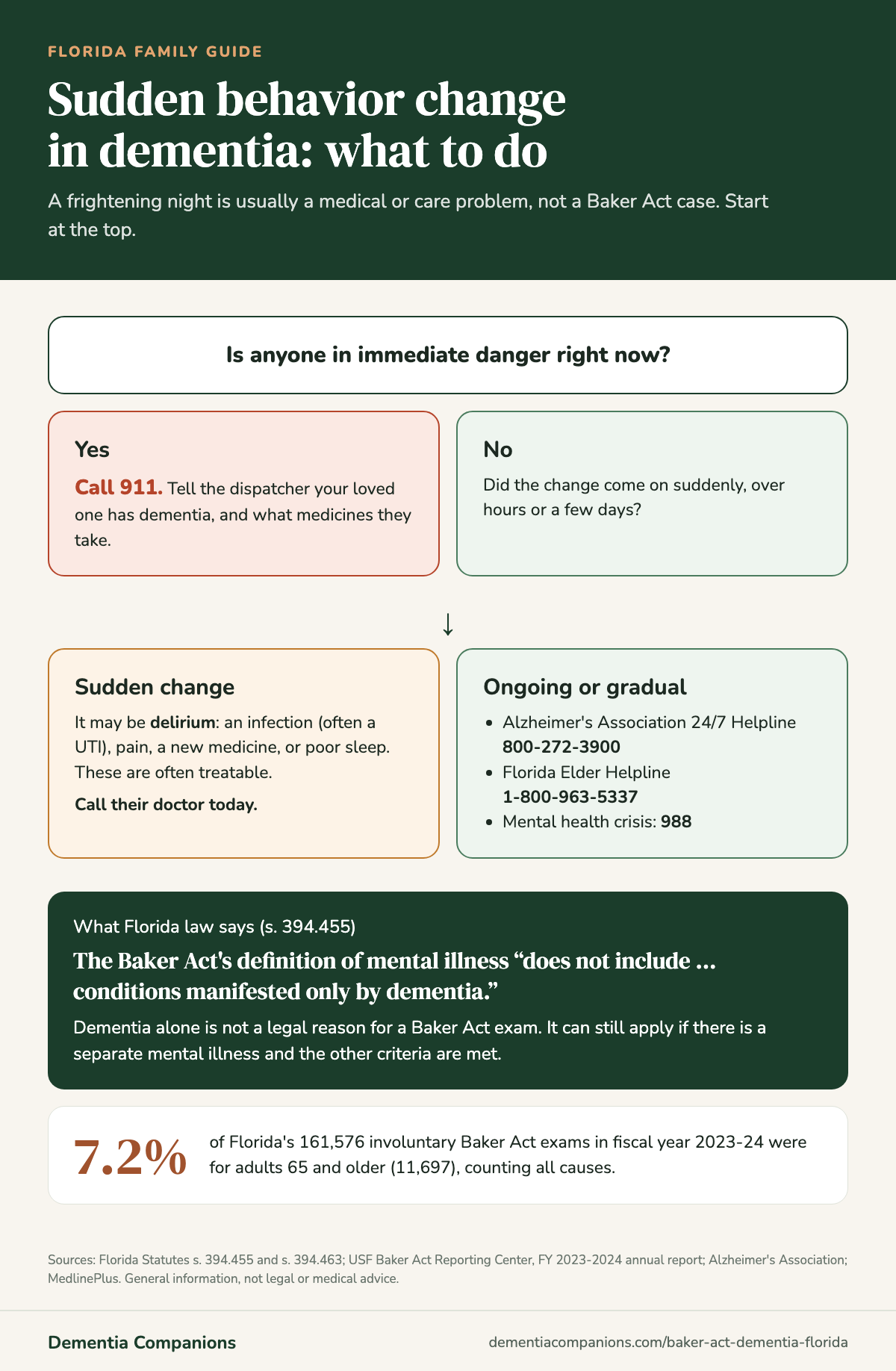
The short answer: You generally can’t Baker Act someone with dementia for the dementia alone. Florida’s Baker Act is a mental health law, and its definition of mental illness specifically leaves out “conditions manifested only by dementia.” So dementia on its own is not a legal reason to Baker Act someone. If a person with dementia also has a separate mental illness, such as severe depression, the Baker Act can still apply, and if anyone is in immediate danger you should always call 911.
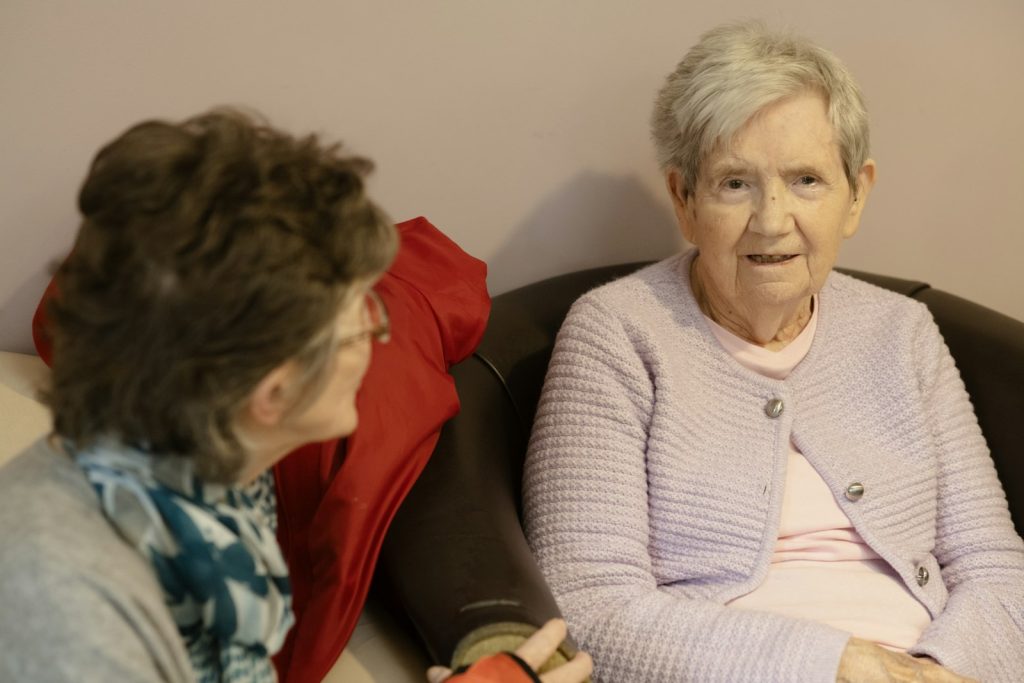
If your mom or dad is frightened, angry, or not making sense tonight, take a breath. Here is what the law says in plain words, and who you can call right now.
What is the Baker Act?
The Baker Act is the common name for the Florida Mental Health Act, found in chapter 394 of the Florida Statutes. It is named after Maxine Baker, the legislator who wrote the first version in 1971. The Florida Department of Children and Families (DCF) describes it as crisis services for people with mental illness, “much like an emergency department is for individuals experiencing a medical emergency.”
Under the Baker Act, a person can be taken, against their wishes, to a “receiving facility” (a hospital or other facility the state has designated for mental health emergencies) for an involuntary examination lasting up to 72 hours.
There are three ways a Baker Act can start:
- A judge signs an order based on sworn testimony.
- A law enforcement officer takes the person into custody because they appear to meet the criteria.
- A professional (such as a physician, physician assistant, clinical psychologist, psychiatric nurse, advanced practice registered nurse, mental health counselor, marriage and family therapist, or clinical social worker) signs a certificate after examining the person within the past 48 hours.
Can you Baker Act someone with dementia in Florida?
Not for dementia alone. Here is the exact wording of the definition in section 394.455 of the Florida Statutes:
“Mental illness” means an impairment of the mental or emotional processes that exercise conscious control of one’s actions or of the ability to perceive or understand reality, which impairment substantially interferes with the person’s ability to meet the ordinary demands of living. For the purposes of this part, the term does not include a developmental disability as defined in chapter 393, intoxication, or conditions manifested only by dementia, traumatic brain injury, antisocial behavior, or substance abuse.
Florida lawmakers added dementia and traumatic brain injury to that list of exclusions in 2020. The Baker Act only applies when there is reason to believe a person has a mental illness, so behavior caused only by dementia does not meet the first requirement.
The law also says a court may not order a person with dementia who does not have a co-occurring mental illness to be placed in a state treatment facility.
It still happens
Even with this rule, people with dementia do end up at receiving facilities, often after police respond to a call and act on what they see. The law itself expects this: it requires the state’s annual Baker Act report to count people with dementia who were taken for an involuntary examination and found not to have a co-occurring mental illness.
For a sense of scale, in Florida’s 2023-2024 fiscal year there were 161,576 involuntary examinations in total, and 11,697 of them (about 7 percent) were for adults age 65 and older. Those numbers cover every reason, not only dementia.
When dementia comes with another condition
The word “only” matters. Some people with dementia also have a mental illness, such as major depression or a psychiatric condition they lived with long before memory problems began. Then the Baker Act may apply if the rest of the criteria are met. Whether someone has a co-occurring mental illness is a medical question for their doctor.
What the Baker Act criteria actually say
Section 394.463 says a person may be taken for an involuntary examination if there is reason to believe they have a mental illness and, because of it:
- They have refused a voluntary examination after it was explained, or they are unable to decide for themselves whether an examination is needed, and
- Either they are likely to neglect or refuse to care for themselves in a way that poses a real and present threat of substantial harm, or there is a substantial likelihood they will seriously hurt themselves or someone else in the near future, based on recent behavior.
One detail is worth knowing. The self-neglect part only applies if it is not apparent that the harm can be avoided with the help of “willing, able, and responsible family members or friends” or other services. When a family is present and helping, that counts.
Sudden behavior changes are often medical
When a parent with dementia suddenly becomes far more confused, agitated, or paranoid, the cause is often not the dementia getting worse. It may be delirium.
MedlinePlus, from the National Library of Medicine, describes delirium as “sudden severe confusion due to rapid changes in brain function that can occur with physical or mental illness.” Common causes include infections such as urinary tract infections and pneumonia, certain medicines such as pain relievers and sedatives, severe lack of sleep, and imbalances in the body’s salts (electrolytes). It is often reversible once the cause is treated. Its advice is simple: contact a health care provider if there is a rapid change in mental status.
The Alzheimer’s Association points out that people with dementia often cannot tell you they are in pain or feel sick, so they may show it through aggression. Pain, infections, and medication side effects are all common triggers, especially for someone who takes several medicines.
What happens if a person with dementia is Baker Acted
If it does happen, here is roughly what to expect:
- Law enforcement takes the person to a receiving facility. The officer must use the least restrictive form of restraint that is appropriate.
- The examination period is up to 72 hours from arrival. A physician, clinical psychologist, or psychiatric nurse working with a psychiatrist must examine the person without unnecessary delay.
- Within that time, the facility must release the person, release them for voluntary outpatient treatment, ask them to agree to stay as a voluntary patient, or file a court petition for involuntary services.
- If the person needs emergency medical care, the hospital handles that first, and the law has separate timing rules for those cases.
Call the facility, tell staff your parent has dementia, and share the name of their doctor and their medication list. The law says the examination should consider information from “knowledgeable individuals,” and that includes you.
If staff ask your parent to sign in as a voluntary patient, ask whether your parent can understand what they are being asked to sign. If you have questions about your rights or your parent’s rights, this is a good moment to call an elder law attorney.
A hospital stay can be hard on someone with dementia. MedlinePlus notes that delirium is common in intensive care units, especially in older adults. Our guide on what to do when someone with dementia goes to the hospital has tips for staying close and keeping them calm.
If your parent lives in assisted living or a nursing home: Florida law says a resident of a licensed facility may not be removed and taken for an involuntary examination unless a court order, a professional’s certificate, or a law enforcement officer’s report is prepared first. If you get a call that this is happening, you can ask which document was used.
Who to call in a dementia behavior crisis
- 911 if anyone is in immediate danger. The Alzheimer’s Association advises telling responders that the person has dementia. You can also ask whether an officer with crisis intervention team (CIT) training is available.
- Your parent’s doctor (or the after-hours line) for any sudden change in behavior or confusion.
- Alzheimer’s Association Helpline: 800-272-3900. It is free, open around the clock every day of the year, and offers crisis assistance and emotional support, with interpreters in more than 200 languages.
- 988 Suicide and Crisis Lifeline: call or text 988. It is free, confidential, and Open day and night, and you can call about a loved one. If your parent talks about wanting to die, call 988 or 911 right away.
- Florida Elder Helpline: 1-800-963-5337 (1-800-96-ELDER). This is not an emergency line, but it is the place to ask about local services, including help through your Area Agency on Aging.
Florida also funds mobile response teams that can come to a home during a mental health crisis, and in 2023-2024 the state reported that about 80 percent of their visits ended with the person stabilized in the community rather than Baker Acted. You can ask 988 or 211 whether a team serves your county. These teams are built for mental health crises, so a medical cause like an infection still needs a doctor.
What to do tonight
- Make sure everyone is safe. Give your parent space and remove anything that could be used to hurt someone.
- Speak slowly and softly. Do not argue or try to correct what they believe.
- Think about what happened just before. Pain, hunger, a full bladder, a new medicine, or a noisy room can all set things off.
- Look for signs of illness: fever, burning when urinating, coughing, a recent fall, or new pain.
- Call the doctor or after-hours line about any sudden change.
- If you feel stuck, call the Alzheimer’s Association Helpline at 800-272-3900.
- If anyone is in danger, call 911 and say the word “dementia” early in the call.
- Write down what happened and when. The doctor will want to know.
Planning ahead so the next crisis goes differently
Once things are calm, a few steps can help:
- Ask the doctor for a full review of medications and possible infections, and for a written plan for what to do if behavior changes suddenly.
- Get a proper diagnosis. Florida’s Alzheimer’s Disease Initiative supports 17 Memory Disorder Clinics across the state that offer diagnostic and referral services for Alzheimer’s and related dementias.
- Look into respite. The same program offers respite care, including emergency respite, through Florida’s 11 Area Agencies on Aging.
- Get legal paperwork in place. An elder law attorney can explain who can make health care decisions for your parent if they cannot. Our guide to legal and financial planning for dementia is a good place to start.
- Make a crisis sheet with the doctor’s number, medications, diagnoses, and the helpline numbers above. Keep it on the fridge and in your phone.
For more statewide help, see our Florida dementia resources.
Some families find a steady, familiar person at home helps with everyday dementia care. Dementia Companions matches Florida families with companion caregivers screened for dementia care experience. You watch video interviews and choose, and every companion completes Florida’s ADRD (Alzheimer’s disease and related dementias) training before the first visit. This is companion care, not medical or home health care, and it does not replace the doctor or emergency services. If it would help, our free family guide walks through the options, or you can call us at (786) 432-5758.
Frequently asked questions
Can you Baker Act someone with dementia in Florida?
Not for dementia alone. Florida’s definition of mental illness excludes “conditions manifested only by dementia.” If the person also has a separate mental illness and meets the other criteria, the Baker Act may apply.
Can you Baker Act an elderly person?
Age does not matter under the law. An older adult can be Baker Acted if there is reason to believe they have a mental illness and they meet the criteria in section 394.463. In 2023-2024, Florida recorded 11,697 involuntary examinations for adults 65 and older.
How long does a Baker Act last?
The examination period is up to 72 hours, starting when the person arrives at the receiving facility. Within that time the person must be released, offered voluntary treatment, or the facility must file a petition with the court. There are special rules when the 72 hours end on a weekend or holiday.
My mom with dementia was Baker Acted. What should I do?
Call the facility, explain that she has dementia, and give them her doctor’s name and medication list. Ask that a medical cause such as an infection be checked. If you have concerns about how she is being held or what she is being asked to sign, contact an elder law attorney.
What is the difference between delirium and dementia?
Dementia usually changes slowly over time. Delirium is sudden, severe confusion, often caused by an infection, a medicine, or another illness, and it can often be reversed once the cause is treated. A sudden change always deserves a call to the doctor.
Still have questions?
Talk it through with us. A free call about your family's situation, with no obligation.
Call (689) 333-6079Send us a message- Screened for dementia care experience
- Florida ADRD training before the first visit
Sources
- Florida Statutes s. 394.455, Definitions (2025): https://www.flsenate.gov/Laws/Statutes/2025/394.455
- Florida Statutes s. 394.463, Involuntary examination (2025): https://www.flsenate.gov/Laws/Statutes/2025/394.463
- Florida Statutes s. 394.467, Involuntary inpatient placement (2025): https://www.flsenate.gov/Laws/Statutes/2025/394.467
- Florida Senate, SB 7012 (2020), Chapter 2020-39: https://www.flsenate.gov/Session/Bill/2020/7012
- Florida Department of Children and Families, Baker Act: https://www.myflfamilies.com/crisis-services/baker-act
- Baker Act Reporting Center, USF, Fiscal Year 2023-2024 Annual Report: https://usf.edu/cbcs/baker-act/documents/ba_usf_annual_report_2023_2024.pdf
- Florida Department of Elder Affairs, Alzheimer’s Disease Initiative: https://elderaffairs.org/programs-and-services/alzheimers-disease-initiative-adi/
- Florida Department of Elder Affairs, Contact Us (Elder Helpline): https://elderaffairs.org/contact-us/
- Alzheimer’s Association, Helpline: https://www.alz.org/help-support/resources/helpline
- Alzheimer’s Association, Aggression and Anger: https://www.alz.org/help-support/caregiving/stages-behaviors/aggression-and-anger
- MedlinePlus, Delirium: https://medlineplus.gov/ency/article/000740.htm
- 988 Suicide and Crisis Lifeline: https://988lifeline.org/
This article is general information, not legal or medical advice. For advice about your family’s situation, talk with your loved one’s doctor or a Florida elder law attorney.
Want a companion screened for dementia care experience?
We'll send 3-5 caregiver video profiles within 48 hours, so you can watch their video interviews before you decide. $35/hour for 40+ hours a week, no contracts.